
Industry News
Bevel Edge Banding Machine Guide: Master 45 Degree Finishes for Modern Cabinets
The global shift toward minimalism in interior design has transformed the woodworking industry. Traditional cabinet doors with protruding handles are being replaced by sleek, handleless silhouettes, often referred to as J-pull or finger-pull designs. At the heart of this manufacturing revolution is the bevel edge banding machine, a specialized piece of equipment designed to handle the complex geometry of non-linear edges.
For factory owners and furniture designers, achieving a seamless finish on a 45-degree angle is no longer a luxury—it is a market requirement. While straight-edge banding is a solved problem in most workshops, the transition to beveled surfaces introduces a host of technical challenges that only a dedicated bevel edge banding machine can resolve with industrial-grade consistency.
Table of Contents
The Engineering Behind 45 Degree Edge Banding
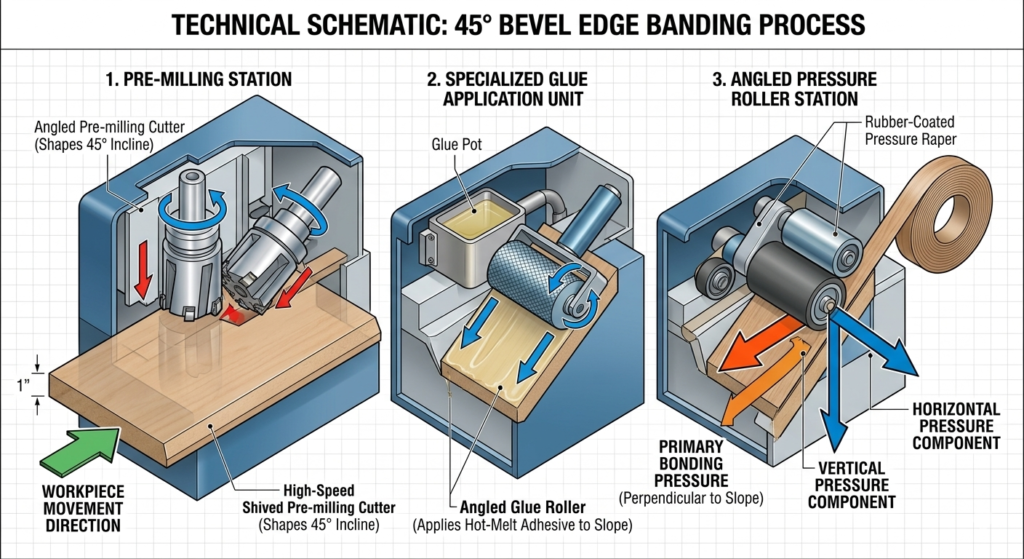
Traditional edge banders apply pressure perpendicular to a flat surface. However, 45 degree edge banding requires the simultaneous management of vertical and horizontal pressure to ensure the tape adheres correctly to the slope. If the pressure is uneven, the resulting gap becomes a “dust trap” that ruins the premium feel of the furniture.
A high-performance bevel edge banding machine utilizes a multi-stage process to ensure stability. It typically starts with a precision pre-milling unit that shapes the board’s edge to the exact angle required. This is followed by a specialized glue application system that ensures the adhesive is spread evenly across the incline, rather than pooling at the bottom of the bevel.
According to technical specifications outlined in the ISO 19085-3 standards for woodworking machinery safety and performance, precision in the feeding mechanism is paramount for angular work. You can find detailed safety and operational frameworks at the International Organization for Standardization (ISO).
Why Kitchen Cabinet Manufacturers are Upgrading
The demand for high-end aesthetics has made the full-automatic bevel and straight edge banding machine for kitchen cabinets the most sought-after upgrade in the B2B woodworking sector. In a high-volume production environment, switching between straight panels and beveled drawer fronts manually is a bottleneck that kills profitability.
The beauty of a modern bevel edge banding machine is its versatility. Operators can switch between standard 90-degree edging and 45-degree beveling without stopping the production line for hours of recalibration. For a company focused on “whole-house customization,” this flexibility is the difference between meeting a deadline and falling behind.
When using a full-automatic bevel and straight edge banding machine for kitchen cabinets, the machine handles the complex trimming and buffing of the angled edge automatically. This eliminates the need for manual touch-ups with a hand-trimmer, which often results in “scuffing” or inconsistent finishes that high-end clients simply won’t accept.
Solving the “Invisible Glue Line” Challenge
In minimalist furniture, the glue line is the enemy. On a beveled surface, a thick glue line is even more noticeable because it breaks the visual flow of the angle. A professional-grade bevel edge banding machine solves this through advanced temperature control and precision glue scrapers.
By using PUR (Polyurethane) adhesives instead of traditional EVA, the bevel edge banding machine can achieve a bond that is not only thinner but also highly resistant to heat and moisture—essential for kitchen and bathroom environments. The precision of 45 degree edge banding depends heavily on the “closed-loop” glue system, which prevents the adhesive from oxidizing and turning yellow over time.
Research from the Wood Component Manufacturers Association (WCMA) highlights that the integrity of the edge bond is the primary factor in long-term furniture durability. You can access their industry reports and quality guidelines at the WCMA Official Site.
Technical Components of a Bevel Edge Banding Machine
To understand why this machine is a heavy-duty investment, one must look at the internal units. A standard bevel edge banding machine consists of several critical stations:
1.Dual-Motor Pre-milling: Specifically designed to cut the 45-degree slope into the MDF or particle board with zero chipping.
2.Tilting Glue Pot: Allowing the glue roller to match the angle of the substrate perfectly.
3.Angled Pressure Rollers: A series of reinforced rollers that apply consistent force to the beveled tape.
4.End Trimming & Fine Trimming: Motors that move on high-precision linear guides to trim the excess tape without nicking the board.
The integration of these units into a single bevel edge banding machine allows for a “one-pass” workflow. This is a massive leap forward from the days when beveled edges had to be painted or finished with labor-intensive T-molding.
Maximizing ROI with Automated Beveling
Investing in a bevel edge banding machine is about more than just “making a pretty edge.” It is about reducing labor costs. Manual 45-degree edging usually requires an expert carpenter and hours of sanding. With a full-automatic bevel and straight edge banding machine for kitchen cabinets, a junior operator can produce hundreds of perfect panels in a single shift.
Furthermore, the bevel edge banding machine significantly reduces material waste. Because the machine’s sensors detect the beginning and end of each panel with millimeter precision, the amount of “overhang” or wasted edge tape is minimized. Over a year of production, these tape savings can contribute thousands of dollars back to the bottom line.
Precision Trimming for High-End Finishes
The most difficult part of 45 degree edge banding is the final trim. On a straight edge, the blade runs parallel to the board. On a bevel, the trimming blade must follow a complex path to ensure it doesn’t leave a sharp or jagged edge.
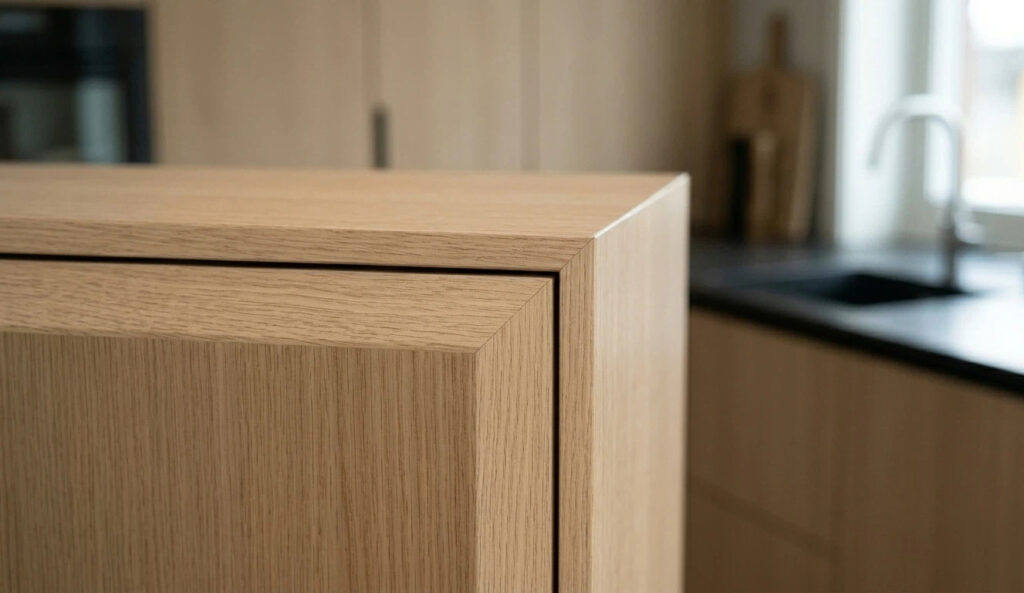
A premium bevel edge banding machine uses a “diamond-tip” milling cutter and a high-speed motor (often exceeding 12,000 RPM) to create a radius or a flush finish on the corner. This ensures that the J-pull handle is smooth to the touch—a critical tactile element for the end consumer.
The European Federation of Woodworking Machinery Manufacturers (EUMABOIS) provides extensive data on the evolution of these trimming technologies and their impact on production efficiency. Technical white papers are available at EUMABOIS.
Future-Proofing Your Workshop
As the market continues to favor “handleless” and “integrated” designs, having a bevel edge banding machine is no longer optional for growth-oriented factories. The ability to offer 45 degree edge banding allows you to bid on premium architectural projects and high-end residential contracts that were previously out of reach.
By implementing a full-automatic bevel and straight edge banding machine for kitchen cabinets, you are signaling to your clients that your facility is capable of executing the most difficult modern designs with surgical precision. In a competitive landscape, that reputation for quality is your most valuable asset.
FAQ
Can I use standard edge tape for 45-degree bevels?
Yes, but the tape must be of high quality (ABS or PVC) and have enough flexibility to conform to the angle without stress-whitening.
What is the maximum angle a bevel edge banding machine can handle?
Most standard machines are optimized for 45 degrees, though some specialized units can be adjusted between 0 and 45 degrees.
Does a full-automatic bevel and straight edge banding machine for kitchen cabinets require special glue?
While standard EVA glue works, PUR glue is highly recommended for beveled kitchen cabinets due to its superior moisture resistance and thinner bond line.
How often should the pre-milling blades be sharpened?
Because 45-degree cutting involves more surface area than straight cutting, blades should be inspected every 500-800 hours of operation to maintain a clean, chip-free edge.
Is it difficult to switch from straight to bevel mode?
On a modern bevel edge banding machine, the transition is usually handled via a PLC touchscreen and takes only a few minutes for the servo motors to reposition the units.