
Industry News
Advanced Curved Edge Banding Machine: Solving the Challenges of Irregular Shape Furniture Production
The furniture industry is undergoing a significant aesthetic shift. Modern interior design has pivoted from rigid, angular structures toward organic, soft-radii forms. Whether it is a minimalist “bean” desk, a circular conference table, or S-curved cabinetry, the challenge for manufacturers has moved from the center of the board to its edges.
Processing these irregular shapes manually is often a recipe for high labor costs and inconsistent quality. Standard machines are designed for straight runs, leaving the complex work to be done with hand-held tools that often result in uneven heat distribution or poor bonding. To stay competitive, workshops are increasingly integrating a dedicated Curved Edge Banding Machine into their production lines.
This technical analysis explores how modern rocker-arm technology solves the historical pain points of curved processing and why high-precision equipment like the D5 and D7 models are becoming industry standards.
Table of Contents
The Engineering Logic: How Rocker Mechanisms Solve Adhesion Failures
The primary difficulty with curved edges is maintaining constant, perpendicular pressure at every point of the arc. In traditional setups, the tape tension varies as the angle changes, leading to the two most common failures: air bubbles (poor adhesion) and surface wrinkling.
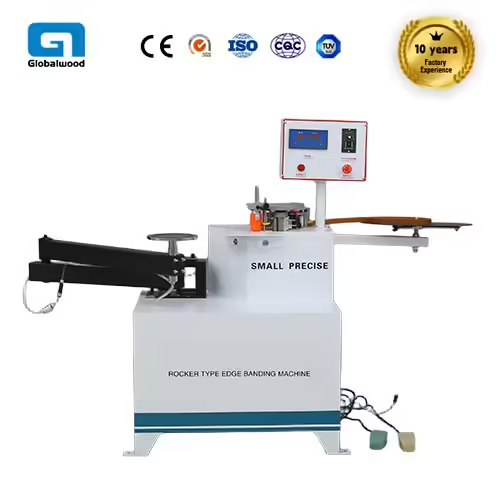
A high-performance Curved Edge Banding Machine utilizes a specialized rocker arm system to mitigate these variables. Unlike static machines, the rocker arm allows the pressure roller to move dynamically with the workpiece. This ensures that the force applied to the PVC or ABS banding remains consistent, regardless of whether the radius is tightening or expanding.
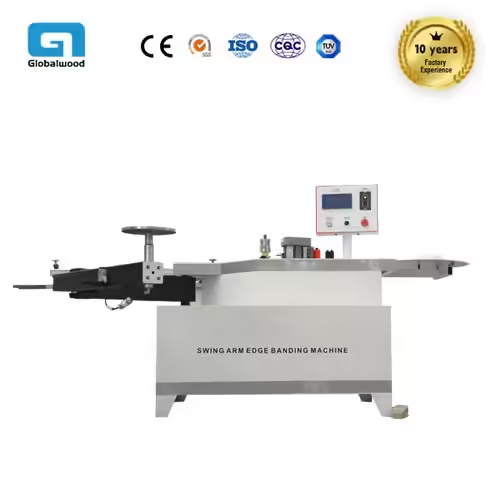
For workshops handling a mix of projects, the curved and linear rocker edge banding machine for irregular shapes offers a dual-path solution. By stabilizing the board against a flexible arm, the operator can maintain a steady feed rate, which is critical for heat-sensitive hot-melt adhesives. When the feed rate is inconsistent, the glue cools too quickly, leading to “cold joints” that eventually peel.
D5 vs. D7: Choosing the Right Benchtop Solution for Your Workflow
When selecting a Curved Edge Banding Machine, the choice often comes down to the scale of the components and the required degree of automation.
The D5 Curved & Straight Line Rocker Edge Banding Machine is engineered for versatility in smaller to medium-sized custom shops. It features a compact footprint but does not sacrifice the ability to handle both straight and curved workpieces. Its primary strength lies in its balance of manual control and mechanical assistance, allowing for a 0.4mm to 3mm tape thickness range.
In contrast, the D7 Curved and Linear Rocker Edge Banding Machine is built for more intensive, heavy-duty applications. The D7 is specifically optimized to be the definitive curved and linear rocker edge banding machine for irregular shapes, featuring a more robust arm construction that handles larger panels with less physical strain on the operator.
Both machines emphasize a “double-sided gluing” approach. By applying glue to both the edge of the panel and the banding tape, the bond strength is significantly increased. This is a critical factor in preventing the “spring-back” effect often seen in high-tension curved applications.
Preventing Wrinkles in PVC and ABS Banding
One of the “unspoken” challenges in edge sealing is the thermal expansion coefficient of the banding material. If the glue pot temperature is too high, the banding tape (especially thin PVC) becomes overly soft and stretches. When it cools, it shrinks, creating wrinkles or visible gaps at the seams.
A professional Curved Edge Banding Machine includes precise temperature controllers that maintain the hot-melt adhesive within a narrow ±2°C window. This is essential for linear edge sealing where the contact time is short, but even more vital for curves where the contact time may vary.
According to research published in the Journal of Adhesion Science and Technology, the “open time” of the adhesive—the window between application and bonding—is the most sensitive variable in woodworking(https://www.sciencedirect.com/topics/engineering/hot-melt-adhesives)]. Modern machines like the D5 use high-precision heaters to ensure the glue remains at its optimal viscosity, facilitating a deep fiber-level bond with the substrate.
Versatility in Practice: From Linear Edge Sealing to Complex Radii
While the name highlights curves, the true value of these machines is their hybrid nature. A shop shouldn’t need two separate machines for a single cabinet. The ability to perform linear edge sealing on the same platform used for curves drastically reduces setup times.
The transition between modes is typically seamless. In linear mode, the rocker arm can be locked or guided to ensure a perfectly straight run. When the operator encounters an irregular geometry, the arm is released, transforming the unit into a high-precision Curved Edge Banding Machine.
This flexibility is what enables the “Zero-Joint” look that high-end clients demand. For custom furniture manufacturers, this means the ability to bid on complex designs—like oval islands or wave-pattern shelving—without worrying about the manual labor bottleneck.
Eliminating Production Bottlenecks in Custom Furniture Manufacturing
For many shops, the “irregular shape” station is where the production flow dies. While the CNC can cut an irregular panel in minutes, the finishing process can take an hour of manual sanding, gluing, and trimming.
Integrating a curved and linear rocker edge banding machine for irregular shapes changes the ROI calculation. By automating the pressure and glue application, the processing time for a circular tabletop is reduced by up to 70%. Furthermore, the reduction in “re-work” (stripping off failed banding and starting over) saves significantly on material costs.
The use of a Curved Edge Banding Machine also enhances worker safety. Manual gluing involves high-heat exposure and repetitive strain on the wrists when trying to force tape around tight corners. The mechanical advantage of the rocker arm takes the physical burden off the employee, leading to more consistent results over an eight-hour shift.
Material Compatibility: Wood, PVC, and Beyond
The D5 and D7 series are designed to work with a wide array of banding materials, including:
- PVC/ABS: The industry standard for durability.
- Wood Veneer: For high-end “all-wood” looks.
- Melamine: For cost-effective office furniture.
The dual-gluing system ensures that even porous particleboard gets enough adhesive to form a structural bond, while the fine-tuned rollers prevent the crushing of delicate veneer tapes. This level of control is why the Curved Edge Banding Machine is considered an “equity-building” asset for a workshop; it expands the range of materials the shop can professionally handle.
Strategic Maintenance for Long-Term Precision
To maintain the accuracy of your Curved Edge Banding Machine, a simple but consistent maintenance schedule is required. The most critical component is the glue pot. Charred glue buildup can clog the spreaders, leading to “streaks” in the adhesive layer which are visible under thin banding.
1.Daily Cleaning: Scrape down the glue rollers and check the scraper blades.
2.Weekly Check: Inspect the pneumatic lines of the rocker arm to ensure there are no pressure drops.
3.Monthly Calibration: Verify the heating element’s actual temperature against the digital readout.
By maintaining the machine, you ensure that the linear edge sealing remains as crisp as the day the machine was installed, and the rocker arm remains fluid enough to follow the most intricate “irregular shape” designs.
Conclusion
The era of the “simple box” in furniture design is fading. As consumers demand more ergonomic and visually interesting pieces, the technical burden on the manufacturer increases.
Investing in a Curved Edge Banding Machine is no longer a luxury for specialty shops; it is a fundamental requirement for any business involved in custom cabinetry or high-end office fit-outs. By mastering the curved and linear rocker edge banding machine for irregular shapes, you eliminate the inconsistencies of manual labor and unlock the ability to produce “impossible” designs with industrial efficiency.
Whether you choose the nimble D5 or the powerful D7, you are ensuring that your shop is ready for the curves of the future. Precision, flexibility, and a perfect bond—that is the promise of modern edge banding technology.
FAQ
How small of a radius can the D5 Curved Edge Banding Machine handle?
While it depends on the thickness and flexibility of your banding tape, the D5 is designed to handle tight internal and external curves, often down to a 20mm radius with proper tape pre-heating.
Does the machine require specialized glue?
It uses standard industrial hot-melt adhesive pellets. However, for high-moisture environments (like kitchens), we recommend high-temp EVA or checking compatibility with PUR adhesives for superior water resistance.
Can one person operate the Curved Edge Banding Machine for large panels?
Yes. The rocker arm is specifically designed to support the weight and movement of the panel, allowing a single operator to guide even large conference table tops through the machine with ease.
Is the D7 suitable for purely linear edge sealing?
Absolutely. While its specialty is curves, the D7 is a heavy-duty hybrid. It performs straight-line sealing with the same speed and precision as a dedicated straight-line machine, making it a space-saving “all-in-one” unit.