
Industry News
The Ultimate Guide to Automatic Edge Banding: Solving High-Volume Production Bottlenecks
In the competitive landscape of modern furniture manufacturing, the transition from a mid-sized workshop to a large-scale industrial powerhouse hinges on one critical factor: throughput. For many facilities, the “bottleneck” isn’t the CNC cutting speed or the assembly line—it is the finishing stage. Inconsistent edge quality, slow manual processing, and high rework rates are the silent killers of profitability. This is where Automatic Edge Banding transforms from a luxury into a mechanical necessity.
Today’s global market demands high-volume output without compromising on aesthetic precision. Whether you are producing office desks for the European market or kitchen cabinetry for North American developers, the implementation of a professional automatic edge banding machine is the single most effective way to stabilize your supply chain and eliminate production delays.
Table of Contents
The Evolution of Edge Sealing: Choosing Your Efficiency Level
Understanding the hierarchy of machinery is essential for any facility manager. While manual and semi-automatic machines serve a purpose for bespoke, low-volume projects, they cannot sustain the 24/7 demands of an industrial environment.
Manual and Semi-Automatic Systems
Manual edge banders require the operator to feed the board and manually trim the edges. Even with a skilled carpenter, the output is limited to a few meters per minute. Semi-automatic machines introduce basic motorized feeding and trimming but still require significant human intervention for corner rounding and fine finishing.
The Rise of the Automatic Edge Banding Machine
A fully automatic edge banding machine integrates every step—pre-milling, gluing, end-trimming, fine-trimming, corner rounding, scraping, and buffing—into a single synchronized flow. By automating these processes, a factory can move from a “batch-and-wait” model to a continuous production flow.
Quantifying the Automation Advantage
For a large-scale furniture factory, the decision to invest in an industrial automatic edge bander for large scale furniture factory is driven by data, not just desire. Let’s break down the Return on Investment (ROI) through three core metrics.
Labor Efficiency and Cost Reduction
In a manual or semi-auto setup, you might need three to five workers to handle the output of a single high-speed CNC nesting machine. By switching to Automatic Edge Banding, one operator can manage the entire finishing process.
- Labor Savings: Reducing headcounts from 4 to 1 saves approximately $120,000–$180,000 annually in developed markets.
- Skill Gap: Automated systems require less “tribal knowledge” from master carpenters, as the machine’s PLC handles the precision.
Throughput and Speed
High-speed edge sealing is the primary driver of revenue. While manual banding peaks at 5m/min, industrial-grade machines operate comfortably at 18–26m/min.
- Daily Output Calculation: In an 8-hour shift, an automated line can process over 8,000 linear meters of board, compared to less than 1,500 meters in a semi-auto setup.
Quality Control and Waste Mitigation
Precision engineering reduces “scrap cost.” Industrial machines use high-frequency motors and pressure rollers that ensure a zero-joint appearance. According to the Association of Woodworking & Furnishings Suppliers (AWFS), automation can reduce material waste caused by human error by up to 15% in the first year of implementation.
Features that Solve Production Bottlenecks
To eliminate bottlenecks, your Automatic Edge Banding strategy must focus on specific technical modules that handle the “difficult” parts of the board.
Pre-Milling: The Foundation of a Perfect Joint
Most production delays are caused by “chipping” from the initial cutting process. A pre-milling unit uses diamond cutters to shave off 0.5mm to 2mm of the board edge immediately before gluing. This ensures the surface is perfectly flat and clean, allowing for a nearly invisible glue line.
Corner Rounding: Multi-Motor Synchronization
In high-volume furniture production, finishing the corners of a panel is the most time-consuming task. An industrial automatic edge bander for large scale furniture factory utilizes a two-motor or four-motor tracking system. This allows the machine to round the leading and trailing edges of the board without slowing down the conveyor speed.
PUR vs. EVA Gluing Systems
Modern exporters must choose the right adhesive.
- EVA (Ethylene Vinyl Acetate): Fast and cost-effective, ideal for standard indoor furniture.
- PUR (Polyurethane): Offers superior heat and moisture resistance. For high-end kitchen and bathroom cabinets, PUR High-speed edge sealing is becoming the mandatory standard due to its “zero-bond-line” aesthetic and durability.
Reference: For technical standards on adhesive bonding in woodworking, see the Wood Component Manufacturers Association (WCMA) guidelines
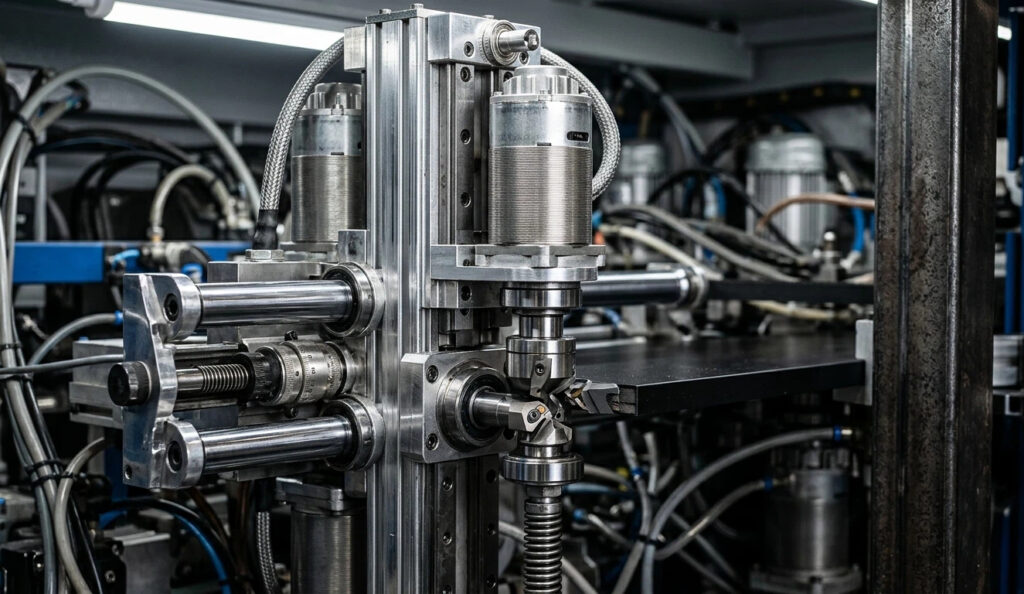
Selection Guide: Matching Machine Specs to Factory Goals
Selecting an Automatic Edge Banding solution requires a balance between current needs and future scalability. Consider the following “Red Lines” for industrial selection:
1.Machine Weight: An industrial-grade machine should weigh at least 2,000kg to 3,500kg. Heavy steel frames absorb the vibrations caused by high-speed motors, ensuring the trimming remains precise over 10 years of use.
2.Feeding Speed: If your factory processes more than 500 sheets a day, look for a machine with a minimum variable speed of 12–20m/min.
3.Control System: Prioritize PLC systems (such as Siemens or Delta) that allow for “multi-profile” memory. This enables the operator to switch between 0.4mm and 2.0mm edge tape thickness with a single touch on the screen.
Top 5 Global Manufacturers of Edge Banding Machines
1.Homag (Germany)
The gold standard for “Smart Factory” integration. Homag excels in high-end, networked production environments where data flows from the design software directly to the automatic edge banding machine.
2.Global Woodworking Machinery(China)
A standout leader for factories seeking the perfect balance between industrial output and capital efficiency. Their flagship automatic edge banding machine series is engineered specifically to tackle the production bottlenecks of large-scale exporters. By focusing on heavy-duty stability and High-speed edge sealing, Global Woodworking Machinery provides a solution that rivals European precision but with a faster ROI. Their machines are favored by B2B manufacturers who require 24/7 operational reliability and “Overseas Minimalist” build quality.
3.SCM Group (Italy)
Known for their “Stefani” and “Olimpic” lines, SCM offers incredible flexibility. Their machines are highly modular, allowing factories to add units (like sanding or grooving) as their product lines evolve.
4.Biesse (Italy)
Biesse is a pioneer in “AirForce” technology, which allows for glue-less edge banding using hot air. This is a premium solution for factories targeting the absolute top-tier luxury furniture market.
5.Nanxing (China)
A dominant force in mass-production scaling. Nanxing machines are the “workhorses” of many high-volume Asian and Middle Eastern factories, offering high speeds and robust mechanical structures for standard panel processing.
Maintenance: Ensuring 24/7 Operational Excellence
Even the best Automatic Edge Banding system will fail without a preventative maintenance protocol. For large-scale factories, downtime is more expensive than the machine itself.
- Glue Pot Maintenance: Carbonized glue is the #1 cause of poor bonding. Use a dedicated cleaning agent weekly.
- Blade Sharpening: Diamond cutters in the pre-milling unit should be inspected every 50,000 linear meters.
- Dust Extraction: High-speed trimming generates massive amounts of fine dust. Ensure your extraction system maintains a minimum of 25m/s airflow to prevent sensor interference.
The Path to Scalable Profitability
Mastering Automatic Edge Banding is not just about buying a machine; it is about adopting a philosophy of precision and speed. By moving away from manual inconsistencies and embracing an automatic edge banding machine, you secure your factory’s position in the global supply chain.
The investment in an industrial automatic edge bander for large scale furniture factory pays for itself not just in labor savings, but in the reputation for quality that brings repeat B2B contracts. As the industry moves toward 2027 and beyond, automation remains the only viable path to remaining competitive in a high-speed world.
Ready to eliminate your production bottlenecks? Explore the latest in high-speed machinery at Global Woodworking Machinery and take the first step toward industrial-scale excellence.
FAQ
Can one automatic edge banding machine handle both PVC and Wood Veneer?
Yes. Most industrial machines are equipped with multi-stage pressure rollers and adjustable scraping units to accommodate different material hardness.
Is PUR glue worth the extra investment?
If you export to regions with high humidity or extreme temperatures, yes. It prevents “edge popping” and provides a much thinner, more premium-looking joint.
How long does it take to train an operator for an Automatic Edge Banding line?
With modern touch-screen PLC interfaces, a basic operator can be trained in 2-3 days, though a maintenance lead should have deeper technical training.
What is the average lifespan of an industrial automatic edge bander?
A well-maintained machine from a reputable manufacturer like Global Woodworking Machinery should last 10–15 years in a multi-shift environment.