
Industry News
Woodworking Machinery Safety Standard: CE Certified Table Saw Guide
In the high-stakes environment of industrial timber processing, the margin for error is non-existent. For manufacturers exporting to European or North American markets, adhering to the latest woodworking machinery safety standard is the definitive benchmark for quality. 2026 marks a pivotal shift in how regulatory bodies view machine-human interaction, placing a heavier emphasis on active suppression systems and fail-safe mechanical barriers.
Whether you are upgrading a single unit or outfitting a mass-production facility, selecting a CE certified table saw is the first step in risk mitigation. This guide breaks down the mandatory engineering requirements that define modern compliance and how high-precision machines, such as the H45 Sliding Table Saw, integrate these features into a high-performance workflow.
Table of Contents
The Foundation: CE Compliance for Machines
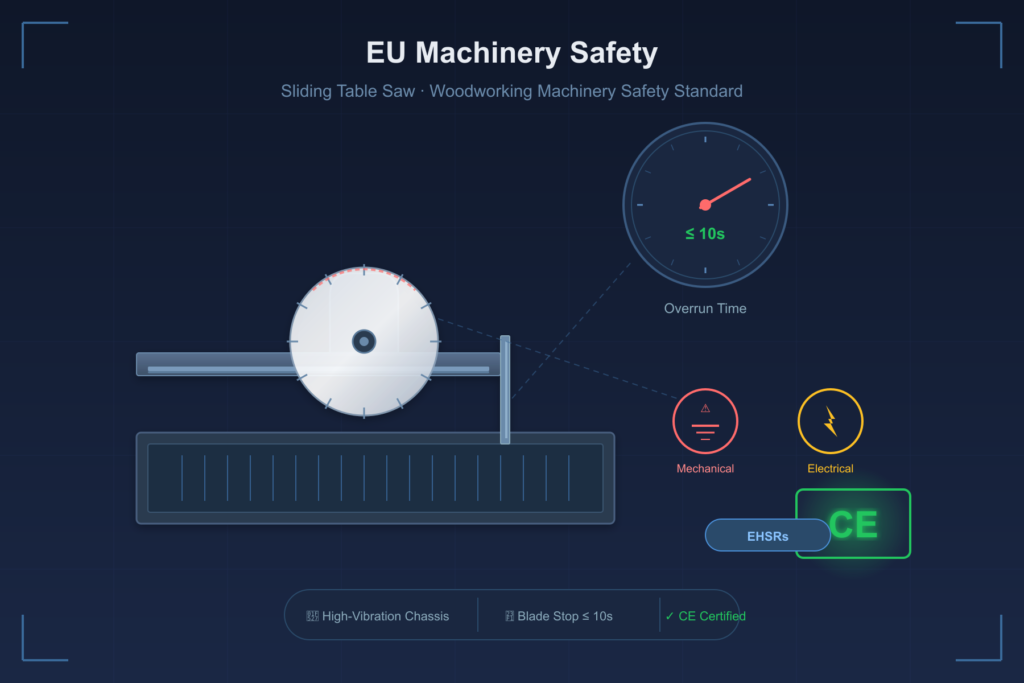
What does CE compliance for machines actually entail in 2026? It is a comprehensive declaration that the equipment meets all essential health and safety requirements (EHSRs) outlined in the EU Machinery Directive. Adhering to a woodworking machinery safety standard ensures that every potential hazard—from mechanical shearing to electrical surges—has been engineered out of the system.
For a sliding table saw, this means the chassis must withstand high-vibration loads without compromising the alignment of the blade. It also dictates the “overrun time”—the duration the blade takes to stop after power-off. Under the current woodworking machinery safety standard, an industrial saw must typically reach a complete standstill within 10 seconds to prevent accidental contact during the coast-down phase.
The Critical Role of the Riving Knife
Perhaps the most vital component in preventing “kickback”—the violent ejection of a workpiece toward the operator—is the riving knife. This curved metallic wedge sits immediately behind the saw blade. Its primary function is to maintain the “kerf” (the gap created by the blade), preventing the wood from pinching the rear of the blade and climbing out of the table.
According to the woodworking machinery safety standard, the riving knife must be adjustable but securely fixed, following the radius of the blade. On advanced models like the H45, the riving knife is engineered to move in tandem with the blade height adjustments, ensuring that the gap between the knife and the blade never exceeds 8mm. This precise geometry is one of the most essential safety features for industrial table saws.
Industrial Feature Comparison: Standard vs. CE Compliant
To help procurement teams evaluate their current inventory against the 2026 woodworking machinery safety standard, we have summarized the key hardware differences in the table below.
| Feature | Standard “Economy” Saw | CE Certified Table Saw (e.g., H45) | 2026 Safety Impact |
| Blade Guarding | Basic plastic cover on riving knife | Independent overhead industrial saw guard | Eliminates finger entry; maximizes dust extraction |
| Braking System | Natural coast-down (30+ seconds) | Electromagnetic brake (<10 seconds) | Prevents contact after power-off |
| Emergency Stops | Single toggle switch | Multiple self-latching E-Stops | Immediate power kill from operator position |
| Riving Knife | Often fixed or removable | Adjustable, follows blade radius | Prevents kickback during varied cut depths |
| Dust Extraction | Single lower port | Dual ports (Lower + Overhead Guard) | Reduces carcinogen exposure (ISO 19085-5) |
Advanced Industrial Saw Guarding Systems
A modern industrial saw guard is no longer a simple plastic cover; it is a sophisticated assembly designed to facilitate dust extraction while providing a physical barrier. The 2026 woodworking machinery safety standard requires that the guard adjust automatically to the thickness of the material or be easily positioned without the use of tools.
On the H45 Sliding Table Saw, the overhead “large-type” saw guard provides total enclosure of the blade. This setup serves two purposes: it prevents the operator’s hands from entering the cutting zone and connects directly to a high-volume vacuum system. Effective dust collection is now a core part of the woodworking machinery safety standard, as wood dust is classified as a significant respiratory carcinogen in industrial settings.
Electronic Safety: Stops and Braking Power
Electronic safety is a cornerstone of the woodworking machinery safety standard. Every CE certified table saw must feature an easily accessible emergency stop (E-stop) button that is “self-latching”—meaning it stays depressed until manually twisted to reset.
Furthermore, the latest woodworking machinery safety standard mandates electromagnetic brakes on motors exceeding a specific kilowatt rating. This ensures that if power is lost or an E-stop is triggered, the blade stops almost instantaneously. High-precision machines like the H45 utilize these heavy-duty braking motors to ensure that high-speed rotations are neutralized within seconds of a safety breach.
Technical Spotlight: The H45 Sliding Table Saw
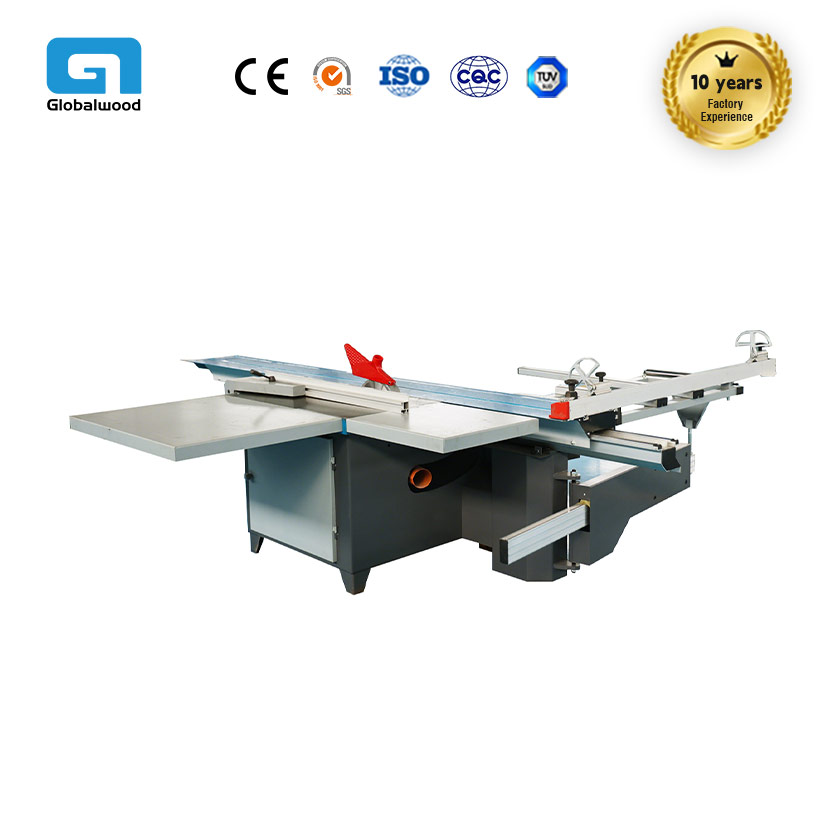
When examining the essential safety features for industrial table saws, the H45 model serves as a primary example of “safety through precision.” It features a 45-degree tilting blade mechanism that is fully enclosed within a heavy-duty steel cabinet. This design ensures that even during beveled cuts, the woodworking machinery safety standard for blade exposure is maintained.
The sliding table itself uses high-strength extruded aluminum with a multi-chamber design. This provides the stability required to guide large panels (up to 3200mm) without the “chatter” or shifting that often leads to binding. By ensuring a smooth, predictable feed rate, the H45 inherently supports the woodworking machinery safety standard by reducing the physical force an operator must apply.
Regulatory Frameworks: ISO and EN Standards
Professional workshops must look toward the EN 1870-19 standard, which specifically governs the safety of circular sawing machines. This woodworking machinery safety standard is the technical document that CE inspectors use to verify the integrity of a machine’s design.
Authority Reference: For a deeper dive into international safety benchmarks, refer to the ISO 19085-5:2024 Woodworking machines — Safety — Part 5: Dimension saws. This standard provides the global framework for the mechanical and electrical safety of table saws.
Compliance with the woodworking machinery safety standard also involves rigorous testing of noise emission levels. Prolonged exposure to decibel levels above 85 dB(A) requires integrated sound-dampening features or clear signage regarding mandatory hearing protection.
Future-Proofing: Training and Documentation
No matter how advanced the hardware, the final link in the woodworking machinery safety standard is the operator. A CE certified table saw must be accompanied by comprehensive manuals in the user’s native language. These manuals must detail “Residual Risks”—hazards that cannot be engineered out, such as the danger of changing blades.
As we move through 2026, the woodworking machinery safety standard will likely begin incorporating digital “interlock” verification, where the machine will not start unless sensors confirm the guard is in place. Investing in compliant machinery today is not just a safety choice; it is a strategic move to avoid future retrofitting costs and potential legal liabilities.
Final Verdict
The 2026 woodworking machinery safety standard is about the harmonization of high-output production and uncompromising operator protection. By focusing on a CE certified table saw with a robust riving knife and an advanced industrial saw guard, you protect your most valuable asset—your workforce—while ensuring your equipment is ready for the global stage.
[View the H45 Sliding Table Saw Specifications] — Discover how our precision engineering meets the most stringent international safety requirements.
FAQ
Can I remove the riving knife for trenching cuts?
Under the woodworking machinery safety standard, the riving knife should only be removed for specific non-through cuts by a qualified operator. For 99% of tasks, it must remain in place to prevent kickback.
What makes a saw guard “industrial” grade?
An industrial saw guard is typically mounted to an overhead “boom” arm rather than the riving knife. This allows for better stability, larger dust extraction ports, and the ability to tilt the blade without the guard interfering with the table.
Is CE certification valid globally?
While CE is a European standard, its requirements often meet or exceed those of OSHA (USA) and CSA (Canada). Adhering to the woodworking machinery safety standard of the EU is generally considered a “best practice” worldwide.