
Industry News
Essential Table Saw Safety Standards: A Complete CE & ISO Compliance Guide
In modern industrial manufacturing, compliance is no longer just a matter of legal paperwork; it is the cornerstone of corporate reputation and employee safety. As global supply chains face increasingly stringent safety requirements in 2026, a deep understanding of Table Saw Safety Standards has become a core consideration for overseas woodworking enterprises when purchasing precision machinery, such as the H45 series.
Whether you are a factory manager facing an annual OSHA inspection or a procurement director looking for reliable export equipment, ensuring that your machinery adheres to international safety protocols is the first step in mitigating operational risk. This guide provides an in-depth analysis of the core technical requirements for sliding table saw safety in the current international market, helping you find the most compliant solutions amidst a complex landscape of regulations.
Table of Contents
Certification Backing: The Role of Table Saw Safety Standards in CE and ISO Compliance
In the global woodworking machinery sector, CE certified woodworking machinery represents the most rigorous safety design benchmark currently available. Equipment bearing this mark must strictly comply with the European Union’s Machinery Directive (2006/42/EC) in terms of design, manufacturing, and operational logic.
For export-oriented businesses, the essence of Table Saw Safety Standards lies in risk assessment. This is not merely about a sticker; it requires the machine to possess automatic protection logic when facing sudden power fluctuations or mechanical failures. For instance, the ISO 19085-5 standard specifically dictates the precision and stability of the sliding table. If a table shifts during high-speed cutting, it doesn’t just damage the workpiece—it can trigger a severe projectile accident.
Physical Defense: Rigorous Guard and Riving Knife Benchmarks
The protection system serves as the first line of defense to prevent operators from coming into direct contact with the saw blade. In any audit of Table Saw Safety Standards, blade guard requirements are prioritized by inspectors.
Technical Advantages of the European-style Overhead Guard
Traditional split-type guards are often removed by workers because they obstruct the line of sight, creating a massive safety loophole. In contrast, the European-style overhead guard utilized by the H45 is the preferred choice for high-end factories. This design can be raised or lowered based on the thickness of the workpiece and integrates an efficient dust extraction port, ensuring that hazardous wood dust does not accumulate in the cutting zone.
Standardized Application of the Riving Knife
The riving knife is the most effective tool for preventing “kickback.” According to Riving knife safety standards, the thickness of the knife must be precisely matched to the kerf of the main saw blade. It must rise and fall with the blade and maintain a safety gap between 3mm and 8mm. Any installation that fails to meet this specific criterion will be flagged as a major non-compliance during a strict factory audit.
Electrical Safety: Emergency Braking and Logic Protection
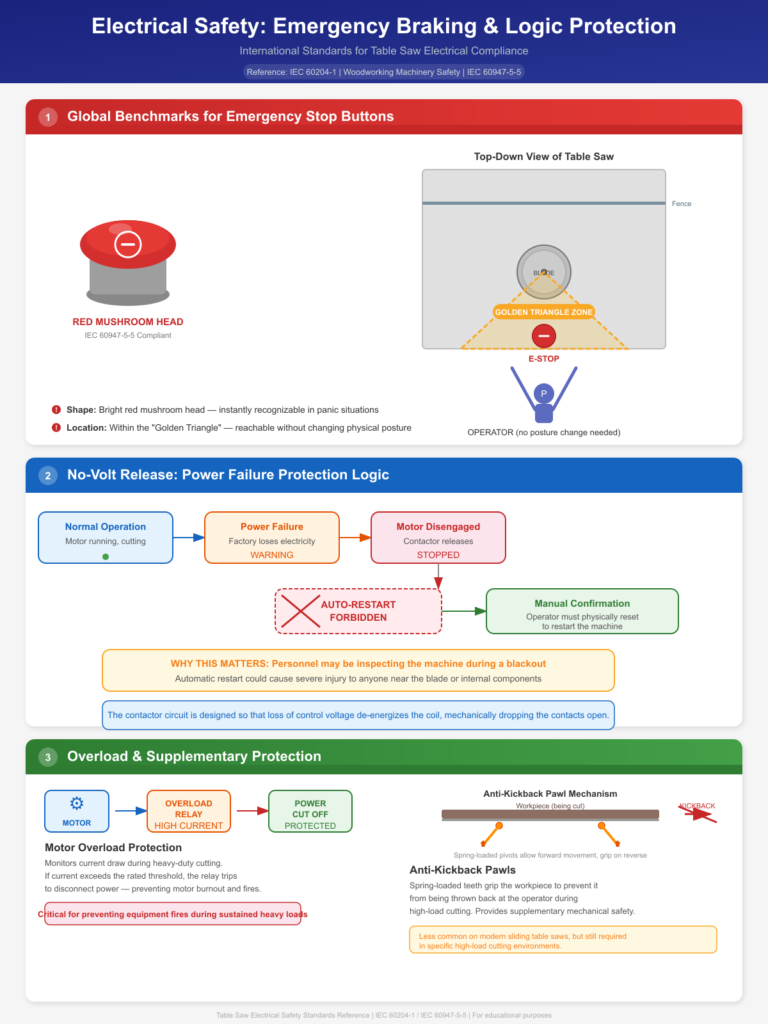
Beyond visible physical barriers, the reaction speed of the electrical system determines survival in extreme circumstances. International Table Saw Safety Standards explicitly reference IEC 60204-1 woodworking safety to define the electrical compliance of a machine.
Global Benchmarks for Emergency Stop Buttons
Emergency stop button location standards mandate that the button must be a bright red mushroom shape and located within the “Golden Triangle”—the area easily reachable by the operator without changing their physical posture. Crucially, the emergency logic must include “no-volt release.” If the factory loses power, the machine must be strictly prohibited from restarting automatically when power is restored. It must require manual confirmation to prevent injury to personnel who might be inspecting the machine during the blackout.
Overload and Supplementary Protection
In heavy-duty cutting, motor overload protection is vital for preventing equipment fires. Furthermore, while less common on modern sliding table saws, Anti-kickback pawls requirements are still used as a supplementary safety measure in specific high-load cutting environments to provide an extra layer of mechanical security.
The Safety Logic of the Scoring Unit
In modern panel furniture production, the addition of a scoring unit increases the complexity of safety. Scoring unit safety requirements dictate that the main and scoring blades must possess independent or linked safety control logic.
The reverse rotation of the scoring blade is not just for aesthetic clean cuts; it also reduces the load pressure on the main blade through pre-cutting, which indirectly enhances physical stability during the process. A compliant scoring unit should feature its own safety guard and an interlocking sensor that automatically stops the motor if the main cover is opened. This granular logic is what separates top-tier equipment from average machinery and reflects the deeper requirements of Table Saw Safety Standards for high-end manufacturing.
Core Checklist for Factory Audits
To assist your production line in meeting Table Saw Safety Standards, we have summarized the following table based on H45 technical specifications and ISO guidelines. We recommend using this as a blueprint for your internal factory audits.
| Audit Focus Item | Technical Compliance Standard | H45 Machine Performance |
| Main Guarding | blade guard requirements (EN 1870-19) | Overhead guard with 95%+ dust extraction |
| Anti-Kickback | Riving knife safety standards | Precision riving knife matched to blade kerf |
| Emergency Logic | Emergency stop button location standards | Ergonomic placement with no-volt release |
| Electrical Wiring | IEC 60204-1 woodworking safety | Fully enclosed, anti-static electrical cabinet |
| Scoring Safety | Scoring unit safety requirements | Independent motor with interlocking sensors |
| Self-Inspection | Table saw safety checklist for factory audit | Comprehensive daily maintenance manual provided |
Authoritative Reference: HSE UK – Safe use of woodworking machinery
Maintenance and Training: The Long-Term Compliance Mechanism
Even with perfect hardware configurations, Table Saw Safety Standards become meaningless without proper maintenance. For example, a dull blade increases frictional resistance, leading to rapid temperature spikes that may trigger the thermal overload protection of the electrical system.
A professional Table saw safety checklist for factory audit should include the following daily checks:
1.Is the gap between the riving knife and the blade tip maintained within 8mm?2
2.Is the transparent panel of the overhead guard damaged or blurred?
3.Does the emergency stop button lock the blade completely within 10 seconds? (This is a fundamental requirement of IEC 60204-1 woodworking safety).
Implementing Table Saw Safety Standards is not just about passing an inspection; it is about protecting the core productivity of your factory. By choosing equipment like the H45, which integrates blade guard requirements and electrical compliance into its initial design, you can focus your energy on the precision and efficiency of your output. Remember, safety is the prerequisite for precision manufacturing, not an obstacle to it.
Conclusion
The rigorous implementation of Table Saw Safety Standards is the only way to build a sustainable, low-risk production environment in the competitive woodworking industry. By investing in machinery that prioritizes safety at the design level, you protect both your bottom line and your workforce. Quality is remembered long after the price is forgotten, but safety is the foundation upon which quality is built.
FAQ
Why can my old table saw work without a riving knife?
While it can technically cut, it drastically increases the risk of kickback. Under modern Table Saw Safety Standards, machines without a riving knife usually fail audits, and insurance companies may refuse payouts in the event of an accident.
What is the difference between CE and UL certification?
CE is primarily for the European market, while UL is used more in North America. However, because CE certified woodworking machinery follows the highest global safety logic, it has become a universally recognized endorsement of quality.
How fast should the emergency brake be?
According to standard requirements, the time from pressing the stop button to the blade reaching a complete standstill should be less than 10 seconds.
Does the dust port on the guard affect safety?
Yes. Excessive dust accumulation obscures the line of sight and increases fire risks, as well as posing respiratory health violations.
Where do factories most often lose points in an audit?
Usually, it is the unauthorized removal of the riving knife, malfunctioning emergency buttons, and improper adjustment of the blade guard.