
Industry News
Mastering Scoring Saw Blade Adjustment: The Secret to Chip-Free Melamine Cutting
In high-volume furniture production, a single millimeter of “tear-out” can turn a premium cabinet door into scrap. For workshop managers and lead technicians, the struggle against brittle surface fractures is constant. While many blame the quality of the board or the sharpness of the carbide, the reality is that the foundation of a perfect finish lies in the precision of your Scoring Saw Blade Adjustment.
A scoring unit exists for one reason: to pre-cut the bottom surface of laminated or veneered panels. Because the main saw blade rotates against the direction of the feed (up-cut), it naturally wants to lift and shatter the exit surface. The scoring blade, rotating in the same direction as the feed (climbing cut), eliminates this upward pressure. However, if your Scoring Saw Blade Adjustment is off by even 0.05mm, the primary blade will either strike uncut material or leave a visible “step” in the panel.
Table of Contents
The Mechanics of Chip-Free Melamine Cutting
To achieve consistent chip-free melamine cutting, you must understand the brittle nature of the resin. Melamine-faced chipboard (MFC) consists of a paper-thin layer of resin that has high hardness but zero elasticity. When the main blade teeth exit the board, they create micro-fractures.
The scoring blade creates a shallow relief cut, slightly wider than the main blade’s kerf. This ensures the main blade never touches the outer edges of the brittle laminate as it exits. Mastering the Scoring Saw Blade Adjustment ensures that this relief zone is perfectly centered. If it is misaligned laterally, you will see “chipping” on one side of the cut while the other side remains clean—a classic sign of X-axis error.
Sliding Table Saw Scoring Blade Alignment (X-Axis)
The most frequent technical error is a lateral misalignment between the scoring unit and the main arbor. A proper sliding table saw scoring blade alignment requires a “test and measure” approach.
1.Take a scrap piece of the exact material you intend to cut.
2.Perform a partial cut, stopping halfway through.
3.Reverse the board and inspect the bottom.
4.The scoring groove must be perfectly symmetrical to the main cut.
If you notice a “ledge” on the left side of the panel bottom, your Scoring Saw Blade Adjustment must be shifted to the right. Modern high-end saws feature electronic adjustment with 0.01mm increments, but for manual machines, this requires fine-tuning the dial until the two cuts are concentric.
The Kerf Game: Scoring Saw Kerf Width vs Main Blade
A common question in the shop is: “How wide should the scoring cut be?” The physics are simple: the scoring kerf must be roughly 0.1mm to 0.2mm wider than the main blade’s kerf. This provides a “buffer zone” that allows for minor vibrations in the sliding table or slight variations in the board’s flatness.
If you are using a Scoring Saw Blade Adjustment that results in a kerf narrower than the main blade, you will fail to prevent wood chipping. The main blade will “over-cut” the scored groove, leading to edge failure.
Conical vs Split Scoring Saw Blades
The method of adjusting width depends on your blade type.
- Conical Blades: These are single-piece blades with a V-shaped profile. You control the width by adjusting the height. Raising the blade increases the kerf width. This is the simplest Scoring Saw Blade Adjustment method, but it can be sensitive to board thickness.
- Split Blades: These consist of two halves with shims in between. To change the width, you must physically add or remove shims. While more time-consuming, this provides a more stable Scoring Saw Blade Adjustment for long production runs because the width remains constant regardless of height.
Recommended Settings for Common Materials
| Material Type | Recommended Scoring Depth | Kerf Overlap (vs Main) | Adjustment Focus |
| Standard Melamine (MFC) | 1.0mm – 1.5mm | +0.10mm | Alignment (X-Axis) |
| Veneered Plywood | 1.5mm – 2.0mm | +0.15mm | Depth to cut fibers |
| High-Gloss Acrylic | 0.8mm – 1.2mm | +0.10mm | Sharpness & Low Vibration |
| HPL (Laminate) | 1.2mm – 1.5mm | +0.20mm | Heat Management |
Eliminating Fuzzy Edges on Veneered Plywood
While melamine shatters, plywood “tears.” Eliminating fuzzy edges on veneered plywood requires a slightly deeper Scoring Saw Blade Adjustment than melamine. Because wood fibers are elastic, the scoring blade needs to sever them completely. If the blade is too shallow, the fibers will simply bend under the pressure of the scoring teeth and then spring back to be torn by the main blade.
To prevent wood chipping in veneered panels, ensure your scoring blade has a high tooth count and a sharp alternate top bevel (ATB) grind. A dull scoring blade is often the secret culprit behind “fuzzy” edges that even a perfect alignment cannot fix.
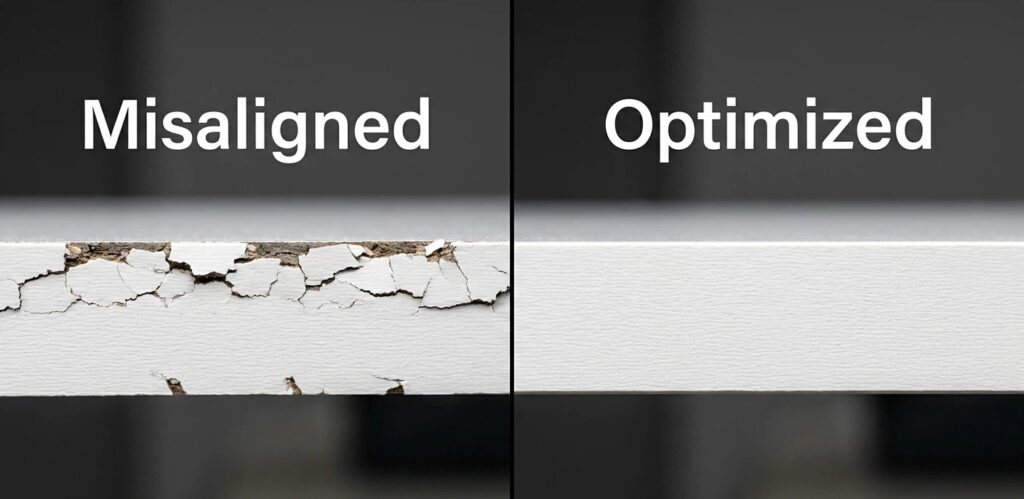
Step-by-Step: How to Stop Melamine from Chipping on Bottom
If you are still seeing jagged edges, follow this systematic Scoring Saw Blade Adjustment checklist:
1.Check Main Blade Run-out: If your main arbor has more than 0.05mm of lateral wobble, no scoring adjustment will save the cut.
2.Verify Height: Set the scoring blade to cut 1.5mm deep. Any deeper, and you risk a “wide step” that looks unprofessional.
3.Lateral Calibration: Run a 500mm test cut. Use a magnifying loupe to see if the chipping is biased to one side.
4.Match the RPM: Ensure your scoring unit is running at its rated speed (usually 8,000+ RPM). Low speed leads to “impact chipping” rather than clean shearing.
By following this routine, you move toward zero-chip cutting for high-end cabinetry, which is the hallmark of a professional shop. A precise Scoring Saw Blade Adjustment reduces the need for manual edge-filing or sanding, directly cutting your labor costs per unit.
Maintenance: The Hidden Factor in Alignment
Even the most expensive Scoring Saw Blade Adjustment mechanism will fail if the machine is dirty. Wood dust can settle behind the scoring arbor, causing it to tilt slightly. This “arbor tilt” makes it impossible to align the scoring blade with the main blade across the entire length of the sliding table.
Regularly clean the adjustment screw threads and lubricate the vertical slides. If your Scoring Saw Blade Adjustment feels “mushy” or loses its setting during a shift, check for loose locking collars or worn-out tension springs.
Conclusion
Mastering the Scoring Saw Blade Adjustment is not just a technical chore; it is a quality control strategy. In a market where customers demand “zero-joint” aesthetics, the quality of your raw cut defines the quality of your finished product. By focusing on the micron-level alignment of your scoring unit, you eliminate waste, protect your margins, and ensure that every panel that leaves your sliding table meets the highest industry standards.
Reference: For further reading on panel processing optimization, visit the Woodworking Network Technical Archives.
FAQ
Why does my scoring blade leave a wider mark on the end of the board?
This is usually due to “table drop” or “clamping pressure.” If the board is not perfectly flat against the table as it exits the blade, the Scoring Saw Blade Adjustment will appear to change.
How often should I sharpen my scoring blade?
A scoring blade should be sharpened every time you sharpen your main blade. Using a dull scorer with a sharp main blade is a recipe for frustration.
Can I use a scoring blade for solid wood?
Generally, no. Scoring blades are designed for laminates and veneers. In solid wood, the scoring blade can cause burning or “climb-out” issues due to grain direction.
What happens if the scoring blade is too high?
If the Scoring Saw Blade Adjustment is too deep, it will create a visible “trench” that the edge-banding cannot always hide, resulting in a poor aesthetic joint.
Is there a “universal” width for scoring?
No. You must match the scoring width to the specific “kerf” of your current main blade. Even blades from the same manufacturer can vary by 0.1mm after multiple sharpenings.