
Industry News
The Ultimate Sliding Panel Saw Guide: Engineering Precision in Industrial Panel Cutting
In the high-precision world of custom cabinetry and industrial millwork, the difference between a high-end finish and a rejected batch often comes down to a fraction of a millimeter. For shop owners looking to upgrade their capabilities, this Sliding Panel Saw Guide aims to bridge the gap between basic operation and industrial mastery. Unlike traditional cabinet saws where the operator moves the wood, the sliding table saw moves the workpiece on a precision-engineered carriage, fundamentally changing the physics of the cut.
This shift in mechanics is the primary reason why large-scale industrial panel cutting requires a more sophisticated approach. When processing expensive laminates or oversized plywood sheets, you need a machine that handles the weight without sacrificing the edge quality. Consequently, understanding the mechanical layout via a reliable Sliding Panel Saw Guide is the first step toward achieving a “zero-defect” production line.
Table of Contents
Mechanical Anatomy: The Foundation of Accuracy
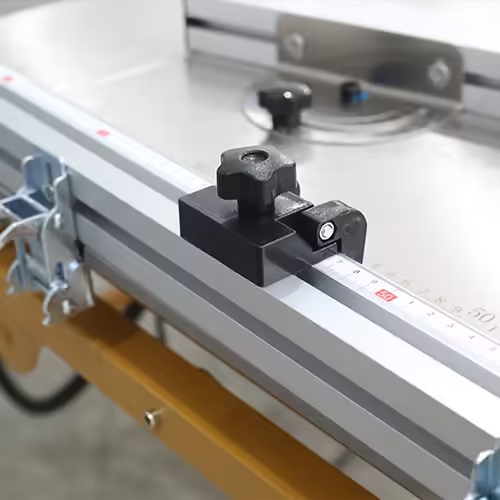
The heart of any sliding saw is the carriage and its rail system. While smaller hobbyist machines might use simple plastic rollers, professional-grade equipment utilizes heavy-duty chrome steel rails. These rails provide the lateral stability needed to prevent “chatter” during the cut.
A robust carriage ensures that even a full-sized 1220 x 2440mm panel remains perfectlyparallel to the blade. Within the context of a professional Sliding Panel Saw Guide,wecategorize these rail systems into three tiers:
1.Ball-bearing guides: Common in entry-level industrial units; smooth but sensitive to dust.
2.Round rod systems: Highly durable, offering excellent load-bearing capacity for solid wood.
3.Linear steel guides: The pinnacle of precision, used in CNC-integrated machines for long-term wear resistance.
The Dual-Blade Synergy: Main and Scoring Units
A hallmark of advanced wood panel saw features is the dual-blade system. Anyone who has worked with double-sided melamine knows the frustration of “tear-out” on the underside of the board. To solve this, industrial machines use a secondary scoring blade that rotates in the opposite direction of the main blade.
As outlined in this Sliding Panel Saw Guide,the scoring unit makes a shallow 1.5mm to2.0mm pre-cut. This ensures that when the main blade exits the bottom of the material, thefibers are already severed, resulting in a perfectly clean edge on both sides. This level of finishis non-negotiable for industrial panel cutting where edge-banding must be appliedimmediately after sizing.
Classification: 45° Tilting vs. 90° Fixed Trunnions
The internal trunnion—the heavy cast-iron assembly that holds the motor and blades—determines the versatility of your machine. This Sliding Panel Saw Guide provides a technical breakdown below to help you choose the right configuration for your specific output:
90° Fixed Units
These are the “workhorses” of the industry. They are designed for one thing: ripping and crosscutting rectangular panels at high speeds. Because the assembly does not tilt, it is significantly more rigid, making it the preferred choice for high-volume carcass manufacturing.
45° Tilting Units
For shops doing custom mitered joinery or architectural cladding, a tilting blade is essential. The complexity of a tilting trunnion requires a higher standard of engineering to ensure that the blade remains aligned with the sliding table throughout its entire range of motion. For those struggling with alignment after long-term use, our Table Saw Calibration and Precision Alignment Guide offers deep-dive troubleshooting.
Technical Benchmarks: Selection Criteria
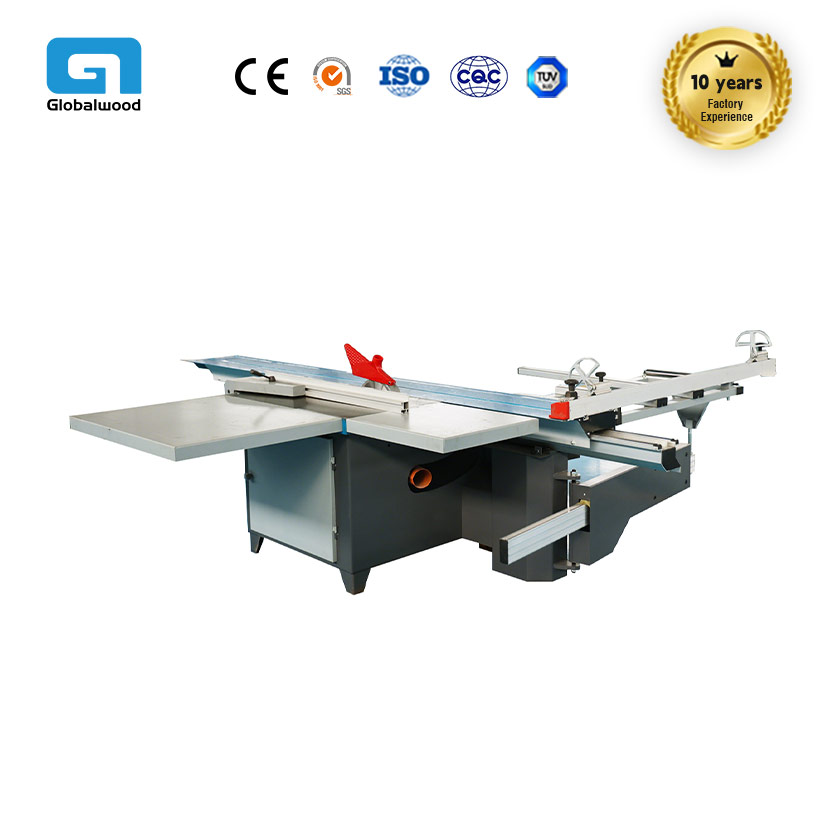
When selecting a machine, the specifications on the brochure can be overwhelming. To simplify the decision process, we have compiled the core parameters that directly affect your ROI and throughput.
Table: Industrial vs. Entry-Level Specifications
| Feature | Entry-Level Industrial | High-Volume CNC Edition | Production Impact |
| Main Motor | 4kW(5.5HP) | 7.5kW(10HP)+ | Ability to cut multiple sheets/hardwoods. |
| Carriage Length | 2600 mm | 3200mm – 3800mm | Capability to process jumbo panels. |
| Rip Fence | Manual with Micro-adjust | CNC Motorized via Touchscreen | Reduces setup time by up to 70%. |
| Max Blade Dia. | 30 mm | 400mm -450mm | Increases max depth of cut. |
| Digital Readout | Optional (DRO) | Integrated PLC Interface | Eliminates human measuring errors. |
The Digital Shift: CNC and Efficiency
Modern iterations of the Sliding Panel Saw Guide focus heavily on digital integration. The industry is moving away from hand-cranks and toward PLC-controlled fences. In traditional industrial panel cutting, an operator might spend 30 minutes a day just walking around the machine to adjust the rip fence.
With a CNC motorized fence, the operator inputs the dimension on a touchscreen, and the fence moves to within 0.1 mm accuracy in seconds. This allows for a massive jump in workflow, especially when combined with a strategy for maximizing panel processing efficiency.
Safety Compliance and Global Standards
High-speed blades require high-level safety. In Europe and North America, machines must meet stringent CE or UL standards. Specifically, this Sliding Panel Saw Guide emphasizes the importance of CE-certified guards (EN 1870-1), which mandate:
- Automatic Braking: The blade must stop within 10 seconds.
- Parallelogram Over-arm Guards: These provide a physical barrier while ensuring optimal dust extraction.
- Riving Knives: Essential for preventing kickback during rip cuts.
According to the Health and Safety Executive (HSE), proper guarding is the most effective way to prevent catastrophic workplace injuries in woodworking environments.
Calibration: The Key to Longevity
A saw is only an asset if it stays square. Central to our Sliding Panel Saw Guide is the concept of routine calibration. Even a microscopic misalignment of the sliding table can cause the back of the blade to “catch” the wood, leading to burn marks or unsafe vibration.
Professional operators use a Sliding Panel Saw Guide to establish a baseline using the “Five-Cut Method.” This procedure allows you to calculate the exact error per meter of cut. If you find your machine is out of tolerance, referring to our Sliding Table Saw Calibration Guide will help you perform the mechanical adjustments needed to return to factory specifications.
Conclusion
Choosing a machine is not just about the upfront cost; it is about the cost per cut over a ten-year lifespan. As this Sliding Panel Saw Guide identifies, the carriage length is the bottleneckof your production capacity. If you regularly handle 2440mm sheets, a 3200mm carriage isthe industry standard for a reason-it allows for a lead-in and run-out space that ensures astraight cut from start to finish.
FAQ
Why is my scoring blade not lining up with the main blade?
This is usually due to vibration or worn bearings. Refer to a professional Sliding Panel Saw Guide for the specific axial and lateral adjustment steps for your trunnion type.
Can I cut solid wood on a sliding panel saw?
Yes. In fact, many wood panel saw features—like the heavy-duty carriage—make it safer for straight-lining large slabs than a standard rip saw.
How often should I replace the scoring blade?
Because it works harder per square inch than the main blade, the scoring blade should be sharpened or replaced every 2-3 cycles of the main blade to maintain industrial panel cutting quality.