
Industry News
How a Profile Edge Banding Machine Perfects Complex Shape Edging
A Profile Edge Banding Machine is the definitive answer to the most frustrating question in modern cabinetry: “How do we stop the edges from peeling on J-pull handles?” For years, furniture manufacturers have excelled at straight-line production, but the moment a design calls for a concave curve or a beveled edge, the rejection rate spikes. The market has shifted toward minimalist, handle-less aesthetics, and if your workshop cannot handle complex shape edging with industrial repeatability, you are leaving your most profitable margins on the table.
In a high-output environment, manual finishing is a bottleneck that kills scalability. This guide explores how transitioning to a high-precision profile edge banding solution allows you to automate the most difficult geometries, ensuring that every panel—regardless of its contour—meets the “zero-joint” standard required by premium buyers. For any production manager looking to scale, the Profile Edge Banding Machine is no longer an optional luxury; it is the cornerstone of a modern, flexible facility.
Table of Contents
Why Are Your Concave Edges Peeling? The Engineering Flaw in Standard Linear Machines
The fundamental challenge of irregular panel edge banding isn’t the adhesive; it’s the pressure. On a standard 90-degree edge, a flat pressure roller applies a constant, perpendicular force. However, when you introduce a concave profile, such as a J-pull, the contact point is a moving target. Standard rollers cannot “reach” into the recess, leading to “pressure gaps” where the edge band fails to bond with the substrate.
Furthermore, edge banding materials like thick PVC or ABS possess “elastic memory.” They naturally want to return to a straight state. Without a specialized Profile Edge Banding Machine that can sustain targeted, multidirectional pressure through the entire cooling cycle, the material will eventually pull away from the MDF core. According to the Woodworking Network, edge banding delamination remains the leading cause of warranty returns in the custom furniture sector, costing shops thousands in onsite repairs and replacements.
How a Profile Edge Banding Machine Masters Curves
To solve the “Curve Curse,” a Profile Edge Banding Machine utilizes a specialized pressure station. Instead of one or two large rollers, these machines use a series of smaller, multi-axis “soft-touch” rollers that mimic the movement of a human hand. They “hug” the profile, following the exact geometry of the workpiece to ensure that the bond is as strong in the deepest part of a curve as it is on a flat surface.
Beyond pressure, thermal management is critical. When performing complex shape edging, the feed speed is often slower to allow the rollers to navigate the geometry. This means the glue has more time to cool down before the final bond is made. Modern systems compensate for this by using localized infra-red heating to keep the adhesive at the exact “open time” temperature throughout the application, a feature commonly found in any high-tier Profile Edge Banding Machine.
Spotlighting the 40 Compact Profile Edge Banding Machine
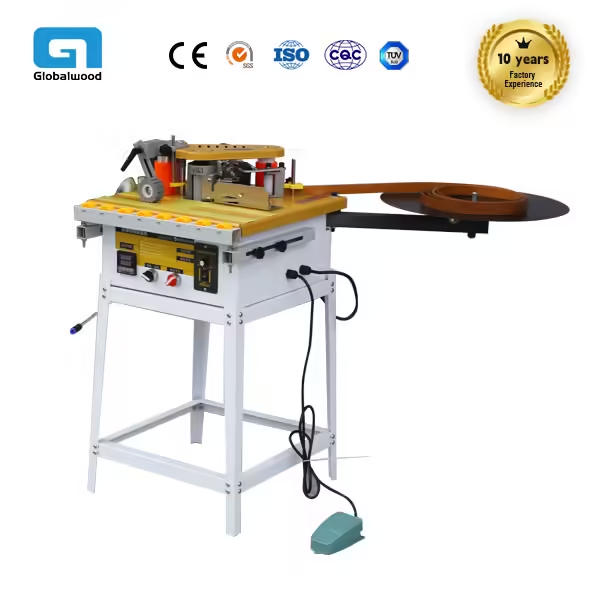
For many mid-sized shops, the dilemma is space. You need the power of an industrial line but cannot afford to have two separate machines for straight and curved work. This is why the 40 Compact Profile and Straight Edge Banding Machine has become a industry favorite. This compact profile edging machine for custom furniture is engineered to switch between standard 90-degree panels and intricate profiles without hours of recalibration.
Key technical advantages of this specific Profile Edge Banding Machine include:
- Integrated Trimming Logic: It features a specialized trimming unit that doesn’t just cut—it follows. This prevents the “over-cut” or “nicking” common on curved panel finishing.
- Narrow-Profile Glue Pot: Designed to work with various adhesive types, including PUR edge banding for profiles, ensuring moisture-resistant bonds for kitchen and bathroom environments.
- Versatile Substrate Handling: Whether you are working with 18mm MDF or 40mm heavy-duty panels, the machine’s tracking system maintains sub-millimeter accuracy.
Achieving the “Invisible Joint” with J-Pull Handle Edging
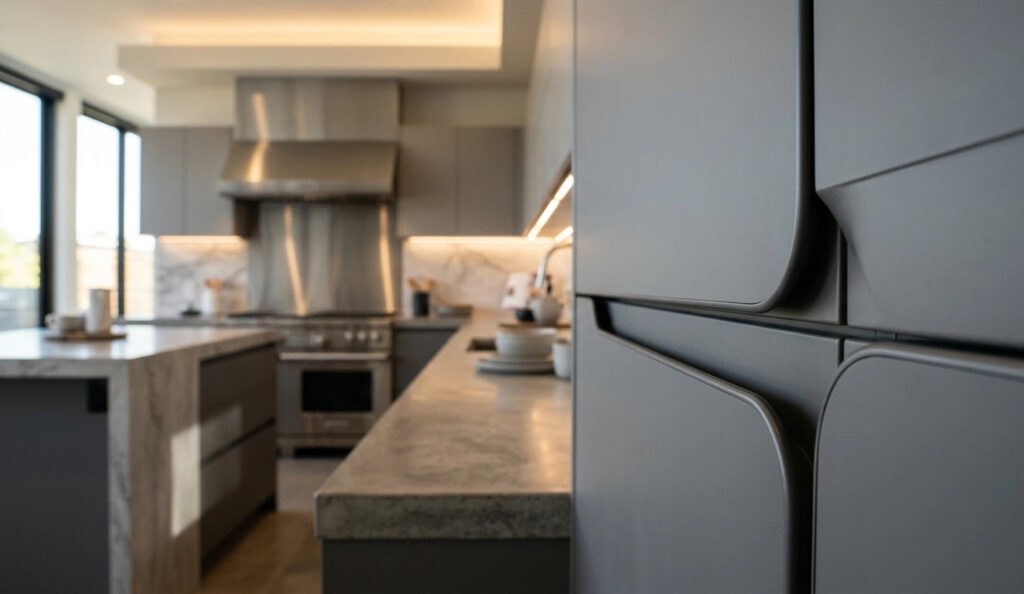
The J-pull is currently the most popular handle-less design, but it is also the most difficult to edge. Because the curve is so tight, the best edge bander for handle-less cabinet doors must manage the feed speed perfectly to avoid scorching the PVC.
Using a dedicated Profile Edge Banding Machine allows you to use thinner, more flexible edge bands that can “wrap” into the handle groove without cracking. When paired with PUR edge banding for profiles, the result is a joint that is virtually invisible and highly resistant to the steam and heat found in modern kitchens. Leading adhesive manufacturers like Jowat emphasize that the chemical cross-linking of PUR is essential for the high-stress bonds required in profile work, as it creates a bond that resists “pull-back” forces better than standard EVA glues.
Automated Contour Trimming: The Secret to High-End Finishes
Even if the bond is perfect, a poor trim will make the entire piece look “cheap.” The most difficult part of complex shape edging is the final cleaning. Manual routing on a curve often leaves a “white line”—the uncolored core of the PVC—or worse, it digs into the wood substrate.
An automated Profile Edge Banding Machine solves this with “contour-following” tracer wheels. These sensors ride along the top and bottom of the panel, feeding real-time position data to the trimming knives. This ensures that the radius of the trim is perfectly consistent, even if the panel has slight thickness variations. For a factory aiming for a high-end finish
The ROI of Moving Beyond Manual Work
If your shop currently relies on hand-held trimmers and heat guns for curved work, you are likely losing 15–20% of your material to scrap. By investing in an automatic edge banding machine for concave and convex profiles, you eliminate the variable of human error. The reliance on a versatile Profile Edge Banding Machine will only increase as custom designs become more complex.
The European Panel Federation reports that automation in secondary processing (like edge banding) is the single biggest factor in increasing shop floor throughput without increasing headcount.For a custom shop, a Profile Edge Banding Machine usually pays for itself within the first 12 months simply through labor savings and reduced rework.
Conclusion
In an industry where competition is fierce, your ability to execute difficult designs determines your market value. You can continue to struggle with manual work and high scrap rates, or you can master the curve by upgrading your line. Choosing to integrate a Profile Edge Banding Machine is about more than just buying a tool; it is about buying the ability to say “yes” to designers and architects who demand the impossible.
As the trend toward integrated handles and organic shapes continues to grow, the gap between “standard” shops and “premium” manufacturers will only widen. In the battle for efficiency and quality, the Profile Edge Banding Machine remains the most critical investment for the modern, high-efficiency woodshop.
FAQ
Why does my edge band snap when doing tight concave curves?
This is usually due to the material thickness or lack of heat. A Profile Edge Banding Machine uses localized heating to make the band more pliable. For very tight radii, ensure you are using a “primer-backed” band designed for profile work.
Can the 40 Compact handle beveled edges (45 degrees)?
Yes. Versatile machines like the 40 Compact are designed for “multi-profile” work, including beveled and slanted edges, making them a high-precision profile edge banding solution for modern office furniture as well.
What is the maximum panel thickness for irregular panels?
Most professional machines, including the 40 Compact Profile Edge Banding Machine, can handle panels up to 40mm thick, which covers almost all standard residential and commercial furniture requirements.