
Industry News
2026 Woodworking Standards: Why an Automatic Edge Sealing Machine is Key to Durable Furniture Edges
In the modern woodworking landscape, the “perceived quality” of furniture has shifted from the grain of the wood to the precision of the finish. For high-end cabinetry and commercial fixtures, the edge is the most vulnerable point of any panel. Whether it is a kitchen cabinet exposed to steam or an office desk subject to daily impact, the integrity of the bond defines the lifespan of the product. This is why the adoption of a high-performance Automatic Edge Sealing Machine has become the baseline for manufacturers who refuse to compromise on structural integrity.
As we navigate through 2026, furniture durability is no longer just a marketing claim—it is a technical requirement driven by rigorous consumer expectations and international standards. A single de-laminated edge can lead to a total product recall or a permanent stain on a manufacturer’s reputation. To achieve truly Durable furniture edges, engineers must look beyond the surface aesthetics and focus on the molecular level of the adhesive bond and the mechanical precision of the application.
Table of Contents
Why Traditional Edges Peel and Warp
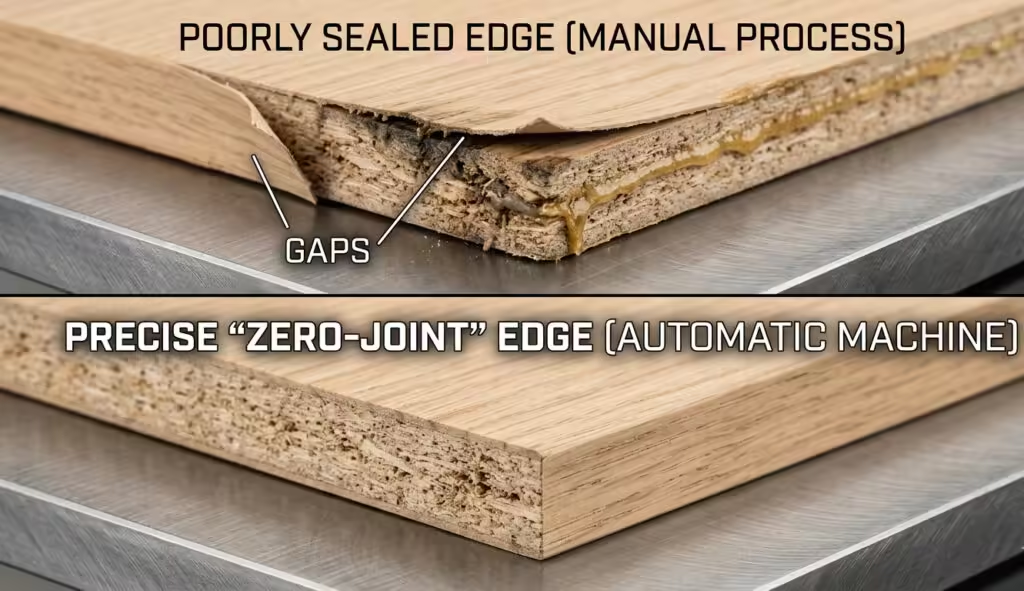
To understand the necessity of an Automatic Edge Sealing Machine, one must first understand the “Wick Effect.” 板材 (panel) cores, such as MDF or particleboard, are essentially compressed fibers with high hygroscopicity. If an edge is not hermetically sealed, the core acts as a sponge. Microscopic gaps between the tape and the substrate allow humidity to infiltrate. This leads to internal swelling, which exerts outward pressure on the adhesive, eventually causing the tape to snap or peel.
In high-humidity environments like kitchens or coastal regions, this process is accelerated. Traditional manual or low-end semi-automatic methods often fail because they cannot maintain the constant pressure and temperature required for a permanent seal. By contrast, a professional-grade Automatic Edge Sealing Machine ensures that the adhesive is forced into the pores of the substrate, creating a mechanical interlock that is nearly impossible to break.
Ensuring a Flawless Bond Base
A common misconception is that the quality of the edge depends entirely on the glue. However, the most critical stage occurs before a single drop of adhesive is applied. In a high-end Automatic Edge Sealing Machine, the pre-milling module is the unsung hero. This unit uses diamond-tipped cutters rotating at high speeds to remove 0.5mm to 1.0mm of the panel edge.
This process eliminates “saw marks” and micro-chips caused by the primary cutting saw. Without pre-milling, these imperfections create tiny air pockets under the tape, which are the primary starting points for moisture ingress. When utilizing a sealing machine for PVC and ABS tape, the pre-milling stage ensures that the board is perfectly square and smooth, allowing for an “invisible glue line.” This level of preparation is the secret behind Durable furniture edges that look like a single, solid piece of material.
The Shift to PUR Technology
By 2026, the industry has largely pivoted away from standard EVA (Ethylene Vinyl Acetate) hot melts in favor of PUR (Polyurethane) adhesives. While EVA is convenient, it remains thermoplastic, meaning it can soften when exposed to heat (such as a stovetop or sunlight). An Automatic Edge Sealing Machine equipped with a PUR melting system offers a chemical cross-linking reaction that, once cured, is irreversible.
This is the gold standard for creating Durable furniture edges. PUR is entirely waterproof and heat-resistant, making it ideal for the “Export Grade” furniture market. If your production line utilizes a specialized sealing machine for PVC and ABS tape, integrating PUR technology allows you to offer a lifetime warranty against de-lamination. Precision models, like the Automatic Edge Banding Machine, are designed to handle these advanced adhesives while maintaining the “no-clean” efficiency that modern factories demand.
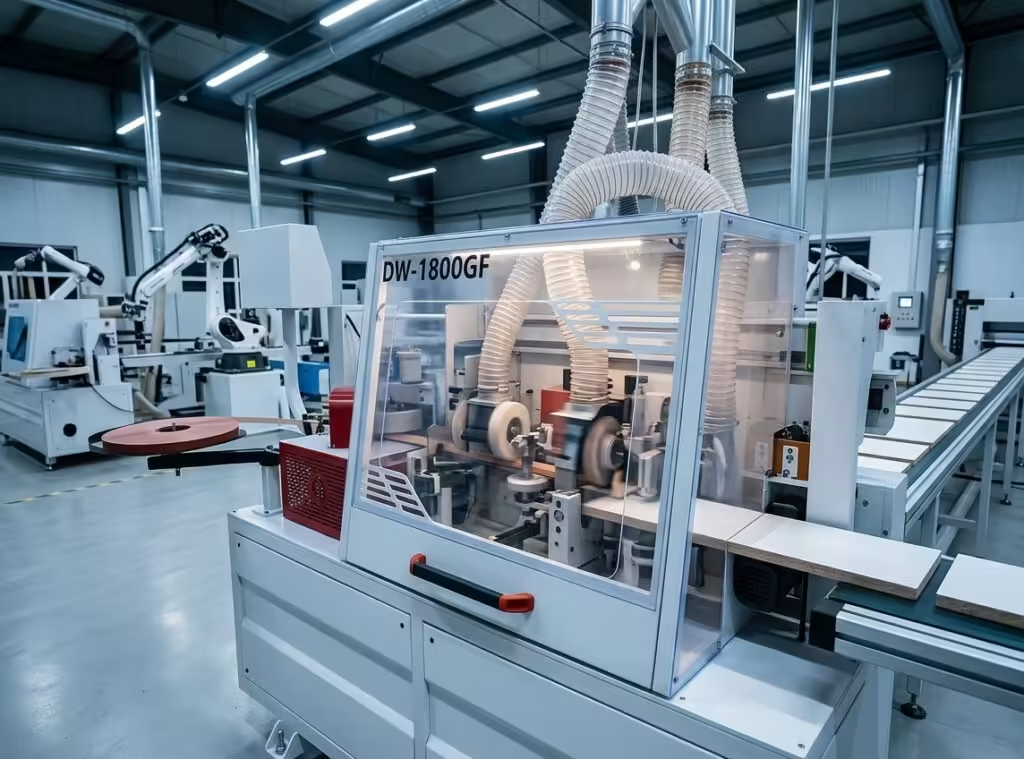
Technical Calibration for a Sealing Machine for PVC and ABS Tape
Not all edge tapes are created equal. PVC is prized for its flexibility and cost, while ABS (Acrylonitrile Butadiene Styrene) is favored for its impact resistance and eco-friendly recyclability. However, ABS has a higher thermal expansion coefficient. A standard Automatic Edge Sealing Machine must be calibrated to account for these differences.
Establishing Professional Technical Standards for Quality Control
To transition from a “workshop” to a “professional manufacturer,” you must move away from visual inspection toward data-driven quality control. A high-performance Automatic Edge Sealing Machine provides the consistency needed to set these standards. We recommend implementing a “90-Degree Peel Test” as part of your daily QC protocol.
In this test, a sample of the edge tape is pulled away from the board at a right angle. In a professional setup, the adhesive should be stronger than the board itself—meaning the wood fibers should tear before the glue fails. If the tape peels off cleanly, it indicates that the Automatic Edge Sealing Machine temperature was too low or the pressure rollers were misaligned. Maintaining this level of rigor is how you build a brand image synonymous with Durable furniture edges.
The ROI of Investing in an Automatic Edge Sealing Machine
For many facility managers, the initial capital expenditure of an Automatic Edge Sealing Machine is a major consideration. However, the true Return on Investment (ROI) is found in the elimination of after-sales service. In the furniture industry, the cost of sending a technician to a customer’s home to repair a single peeled cabinet door often exceeds the profit of the entire kitchen project.
By using a reliable sealing machine for PVC and ABS tape, you virtually eliminate these “hidden costs.” Furthermore, the automation reduces the reliance on highly skilled manual labor, which is becoming increasingly scarce and expensive. The throughput of a modern Automatic Edge Sealing Machine can replace three to four manual workstations, allowing your facility to scale without increasing its footprint.
Conclusion
The woodworking industry has entered an era where “good enough” is no longer an option. As global trade increases and consumer protection laws tighten, the ability to produce Durable furniture edges is the ultimate competitive advantage. The Automatic Edge Sealing Machine is the heart of this transformation, turning a complex chemical and mechanical process into a repeatable, automated success.
By optimizing your sealing machine for PVC and ABS tape and adhering to international quality standards, you aren’t just making furniture—you are engineering reliability. Whether you are a large-scale exporter or a high-end custom shop, the investment in a professional Automatic Edge Sealing Machine is the most direct path to establishing a reputation for excellence in a demanding market.
[Discover the technical specifications of our latest Automatic Edge Banding Machine and elevate your production standards today.]
FAQ
Why does moisture still get into my boards despite edge sealing?
This is often due to the absence of a “Pre-milling” unit. If the board has micro-chips from the saw, the Automatic Edge Sealing Machine cannot create a hermetic seal. Ensure your machine is equipped with diamond pre-milling cutters.
Is it better to use PVC or ABS tape for commercial office furniture?
ABS is generally preferred for commercial use because it is more impact-resistant and does not produce toxic gases if burned. Ensure your sealing machine for PVC and ABS tape is set to the correct scraping angle to avoid “white edges” on ABS.
How often should I clean the glue pot of my Automatic Edge Sealing Machine?
If using EVA, a weekly check is sufficient. However, if you are running PUR for Durable furniture edges, the system must be flushed or sealed daily to prevent the adhesive from curing inside the pot.
Can an Automatic Edge Sealing Machine handle curved panels?
Most standard industrial machines are designed for “straight-line” high-speed work. For curved work, you would typically need a specialized contour banding machine, though some high-end units now offer “soft-forming” capabilities.