
Industry News
Why Choose High-Precision Benchtop Table Saw for Small Woodworking Shops?
For most woodworkers, the benchtop table saw is the heartbeat of the workshop. Whether you are a professional contractor needing portability or a furniture maker working in a space-constrained environment, the table saw is the primary tool responsible for establishing straight edges and square dimensions. However, the term “benchtop” often covers a wide spectrum of quality—from lightweight DIY tools to precision-engineered machinery that bridges the gap into industrial territory.
A benchtop table saw is fundamentally defined by its compact footprint and lack of a dedicated floor cabinet. While its primary appeal is portability, the real challenge for any user is maintaining the accuracy of portable table saws for furniture making. Without the mass of a cast-iron cabinet saw, these machines must rely on superior engineering and material selection to prevent vibration and ensure that every rip cut is perfectly parallel to the fence.
Table of Contents
What is a Benchtop Table Saw and Why Does it Matter?
By definition, a benchtop table saw is designed to sit atop a dedicated workbench or a mobile stand. It is the go-to solution for those who need a compact table saw that can be stowed away when not in use. Unlike its larger cousins, it utilizes a universal motor to keep weight low, allowing a single operator to transport it between jobsites. This is why many professionals refer to them interchangeably as a jobsite table saw.
The role of this tool extends beyond simple rough cutting. In a modern workshop, it is used for joinery, such as cutting tenons, rabbets, and grooves. The versatility of a benchtop table saw allows it to handle everything from plywood sheets to hardwood slabs, provided the machine is calibrated correctly. For those searching for the best benchtop table saw for small shop use, the decision often hinges on the balance between motor power and the quality of the rip fence.
The role of this tool extends beyond simple rough cutting. In a modern workshop, it is used for joinery, such as cutting tenons, rabbets, and grooves. The versatility of a benchtop table saw allows it to handle everything from plywood sheets to hardwood slabs, provided the machine is calibrated correctly. For those searching for the best benchtop table saw for small shop use, the decision often hinges on the balance between motor power and the quality of the rip fence.
How to Choose the Right Saw
When evaluating a benchtop table saw, you must look beyond the sticker price. The difference between a tool that “cuts wood” and a tool that “builds furniture” lies in the tolerances.
1.The Rip Fence and Accuracy
The fence is the most critical component. If the fence deflects under pressure, your cuts will be burnt or, worse, you risk a dangerous kickback. When considering a benchtop table saw vs. jobsite saw, look for a rack-and-pinion fence system. This mechanical adjustment ensures the fence stays perfectly parallel to the blade at both ends.
2.Motor Power and Torque
Most compact saws use 15-amp motors. However, the internal gearing determines how that power is delivered. A high-quality benchtop table saw should maintain consistent RPM even when feeding dense hardwoods like oak or maple.
3.Safety Mechanisms
Modern standards require several safety features to look for in a compact table saw. This includes a riving knife to prevent wood from pinching the back of the blade and an easily accessible emergency stop paddle.
Comparative Analysis: From Portable to Professional
To help you understand where to invest, the following table compares standard portable units with professional-grade precision equipment.
| Feature | Standard Benchtop Table Saw | Professional Precision Upgrade (H45) |
| Primary Use | Framing & Light DIY | Precision Joinery & Panel Sizing |
| Portability | High (Can be carried) | Stationary (Industrial Grade) |
| Cutting Mechanism | Fixed Table / Moving Fence | Sliding Table / Fixed Material |
| Max Rip Capacity | 24″ – 32″ | Industrial Standard |
| Table Surface | Cast Aluminum | Precision Ground Cast Iron |
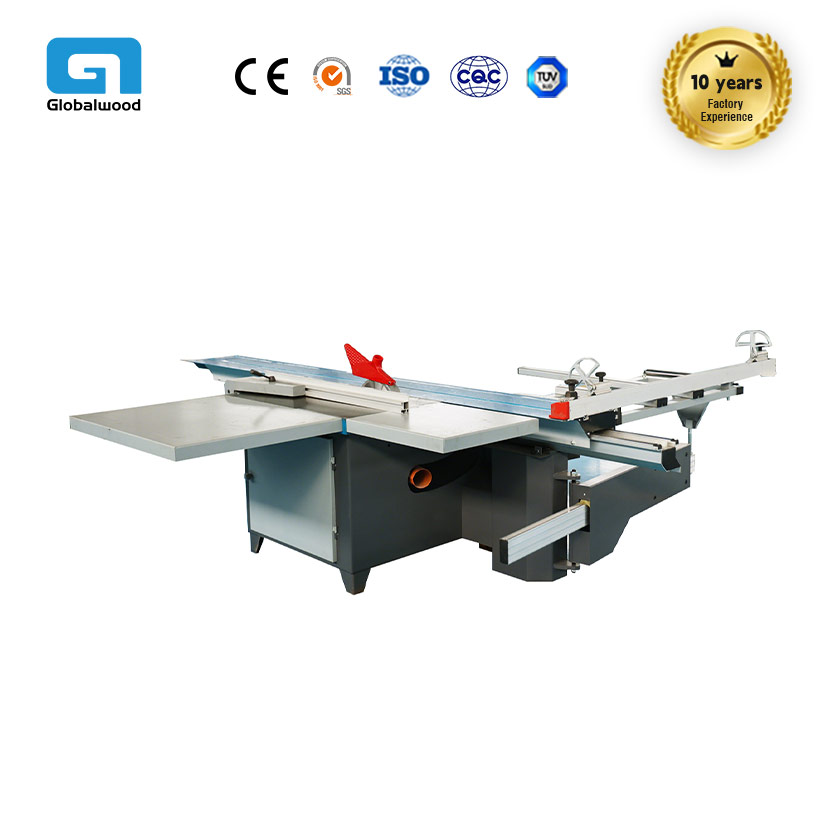
Precision Upgrade: The H45 Sliding Table Saw
There comes a point where a standard benchtop table saw hits its physical limit, especially when attempting Large panel cutting. If your projects involve oversized sheets or you require absolute zero-clearance precision, you must look toward industrial-grade sliding technology.
The H45 Precision Sliding Table Saw represents the ultimate evolution of the table saw. While it occupies more space than a basic benchtop table saw, its sliding carriage eliminates the friction of pushing wood against a stationary table. In a professional environment, the H45 is used to achieve the level of Large panel cutting accuracy that portable saws simply cannot match. By moving the table rather than the wood, the operator gains total control, ensuring that the finish is free of “tear-out” or surface defects.
Best Benchtop and Precision Woodworking Saws in 2026
If you are looking to equip your shop, these five models represent the pinnacle of current technology:
1.The Jobsite Standard (DeWalt DWE7491RS): Renowned for its rack-and-pinion fence, this is the benchmark for a high-performance jobsite table saw.
2.The Safety Leader (SawStop Compact): The only compact table saw with skin-sensing technology, making it the safest choice for schools and home shops.
3.The Precision Specialist (H45 Sliding Table Saw): As mentioned, this is the pro’s choice for precision woodworking saw tasks. It is designed for those who have outgrown a benchtop table saw and need industrial reliability.
4.The Workshop All-Rounder (SKILSAW Worm Drive): Known for its immense torque, this saw excels at heavy ripping through thick timber.
5.The Compact Value (Bosch GTS1031): The ultimate best benchtop table saw for small shop owners who need to store their tools in a cabinet or under a bench.
Maintenance for Long-Term Accuracy
Even a top-tier benchtop table saw will lose its edge if not maintained. Dust is the enemy of precision. Wood particles can build up in the worm gears that control the blade height and bevel angle, leading to “slop” in the adjustments.
Even a top-tier benchtop table saw will lose its edge if not maintained. Dust is the enemy of precision. Wood particles can build up in the worm gears that control the blade height and bevel angle, leading to “slop” in the adjustments.
Conclusion
Choosing a benchtop table saw requires an honest assessment of your workflow. If your priority is moving between jobsites, a high-quality portable table saw with a mobile stand is your best asset. However, if you are building fine cabinetry and find yourself limited by the table size and fence stability, upgrading to a professional sliding system like the H45 is the logical next step.
By focusing on safety, motor torque, and the precision of the fence, you can turn a small workspace into a world-class production center. Whether it is a compact table saw or a full-scale sliding machine, the goal remains the same: a perfect cut, every single time.
FAQ
Is a benchtop table saw powerful enough for thick oak?
Yes, most 15-amp saws can handle 2-inch thick oak, provided you use a dedicated “ripping blade” with a lower tooth count to prevent burning.
Can I use a dado blade on a compact table saw?
Only if the arbor is long enough and the manufacturer specifies it. Many small benchtop table saw models are not designed for the weight and width of a dado stack.
Why is my table saw “burning” the wood?
This usually happens if the blade is dull or if the fence is not perfectly parallel to the blade, causing the wood to pinch against the back of the saw.