
Industry News
Large Panel Cutting: Engineering Stability for 3.2m Sheet Processing
In the modern woodworking industry, the transition from standard furniture components to architectural-scale projects has redefined the requirements for primary breakdown machinery. Large panel cutting—specifically involving 2.8m or 3.2m formats—presents unique physical challenges that standard equipment cannot adequately address. When a single sheet of high-density MDF or marine-grade plywood weighs upwards of 70kg, the variables of structural deflection, vibration, and operator fatigue become critical factors in production efficiency.
For workshops aiming to scale, the ability to handle Large panel cutting with precision is not just about having a bigger table; it is about the physics of the machine’s chassis and the fluid dynamics of the sliding mechanism. Without a rigid foundation, a 3200mm cut will inevitably suffer from cumulative deviation, leading to expensive material waste and secondary processing costs.
Table of Contents
Why Chassis Weight Matters
The foundation of any successful Large panel cutting operation is the machine’s base. Standard saws often utilize thin-gauge sheet metal frames that resonate during heavy-duty operations. In contrast, a heavy-duty sliding table saw utilizes a reinforced, vibration-dampening chassis. This mass is essential because it absorbs the kinetic energy generated by the 5.5kW motors and the momentum of a moving 3.2-meter aluminum table.
In a high-volume environment, even microscopic vibrations can lead to “chatter marks” on the cut edge. This is particularly problematic during plywood sheet processing, where veneers are prone to chipping. By utilizing a heavy-duty chassis, such as the one found in the Sliding Table Saw H45, manufacturers ensure that the alignment between the main blade and the scoring unit remains constant, regardless of the board’s weight.
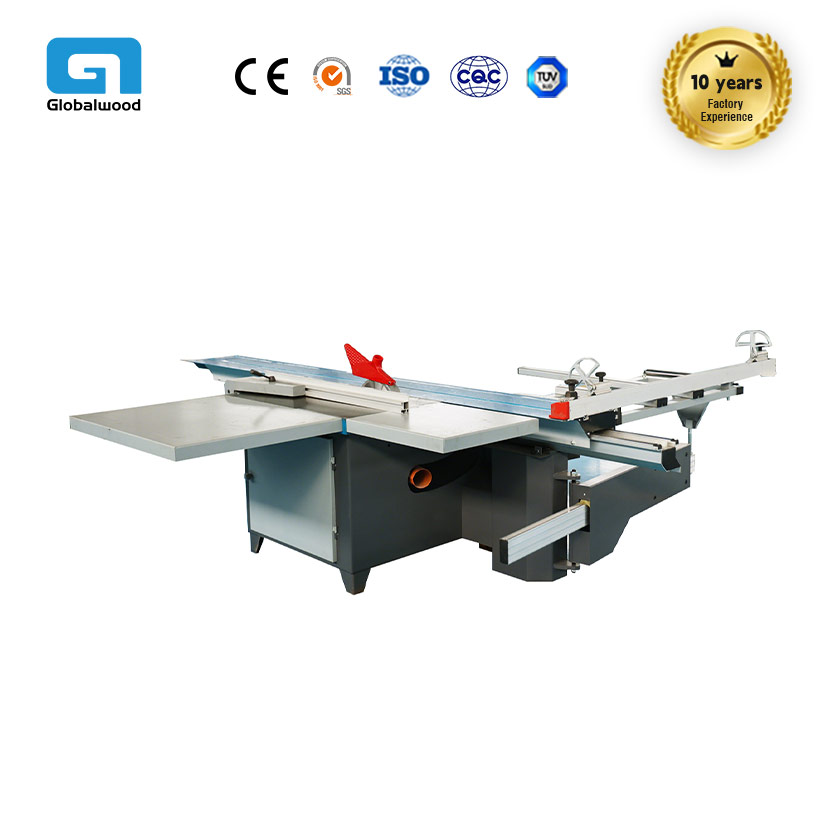
Precision Over 3200mm: Eliminating Cumulative Deviation
When performing Large panel cutting, the margin for error shrinks as the length of the cut increases. A deviation of 0.05mm at the start of a cut can expand to over 0.5mm by the end of a 3.2-meter sheet if the guide system is not engineered for linear accuracy.
The industry benchmark for high-precision Large panel cutting involves the use of chrome-plated round bar rails or high-precision linear guides. These systems distribute the load of the oversized panels across a wider surface area. The H45 series, for instance, integrates SKF bearings from Sweden, which are renowned for their low friction coefficient and long-term durability. According to ISO 19085-5 standards, which govern the safety and performance of woodworking machines, the stability of the sliding table is paramount to preventing kickback and ensuring dimensional accuracy.
Technical Specification Comparison for Large Format Sawing
| Feature | Standard Panel Saw | Heavy-Duty H45 Series | Impact on ROI |
| Max Cutting Length | 2400mm – 2800mm | 3200mm (Standard) | Handles jumbo sheets |
| Main Motor Power | 3.0kW – 4.0kW | 5.5kW (High Torque) | Faster feed speeds |
| Guide Rail Type | Basic Ball Bearing | Chrome-Plated Round Bar | Longevity & Load capacity |
| Accuracy Tolerance | ±0.5mm | ±0.1mm | Minimal material waste |
| Bearing Quality | Domestic Grade | SKF (Sweden) | Reduced maintenance costs |
Optimizing Plywood Sheet Processing: One-Person Workflow
One of the most significant “hidden costs” in a workshop is the need for two operators to manage a single machine. Traditional Large panel cutting often requires a second person to support the off-feed or to help align the sheet against the rip fence.
Modern heavy-duty sliding table saw designs solve this through ergonomic enhancements:
1.Electric Lifting & Tilting: Digital control of the blade height and angle allows the operator to make adjustments from the control panel without leaving their station.
2.Extended Support Frames: Outrigger tables with telescopic fences provide the necessary leverage to swing a 3.2m sheet into position solo.
3.Digital Readouts: By replacing manual scales with digital displays, the operator can set the rip fence to within 0.1mm accuracy instantly, which is vital for high-quality plywood sheet processing.
Efficient Large panel cutting requires that the machine does the “heavy lifting,” allowing the operator to focus on alignment and safety rather than physical exertion.
Preventing Edge Failure in Melamine and Plywood
For any facility involved in plywood sheet processing, the quality of the finish is non-negotiable. Large format sheets are often expensive, featuring sensitive melamine or high-pressure laminate (HPL) surfaces. Large panel cutting without a dedicated scoring unit (usually 1.1kW) results in bottom-edge chipping.
The technical advantage of the H45 is the independent motor for the scoring blade. This ensures that the scoring unit maintains a consistent RPM (usually around 8000 RPM) regardless of the load on the main saw blade. This synchronized dual-blade system is the only way to achieve “glue-line” quality cuts on oversized sheets in a single pass.
Maintaining Accuracy Over Time
A common mistake in Large panel cutting is assuming that a machine which is accurate on Day 1 will remain so on Day 1000. Thermal expansion and mechanical fatigue are real threats to precision. Authoritative research from institutions like the Fraunhofer Institute for Wood Research (WKI) emphasizes that the stability of the guide rail material directly impacts the lifecycle of the machine.
Using a heavy-duty sliding table saw with a 375mm or 380mm wide aluminum table provides a wider footprint, which prevents the “table dip” often seen in lighter models after years of processing heavy MDF. Regular calibration is still necessary, but a machine engineered for Large panel cutting will hold its settings much longer under industrial stress.
Conclusion
Mastering Large panel cutting is a prerequisite for any workshop looking to enter the high-end custom cabinetry or architectural millwork markets. The shift toward 3.2m formats requires a move away from “hobbyist” setups and toward a heavy-duty sliding table saw that can withstand the rigors of 8-hour shifts.
By investing in a platform like the Sliding Table Saw H45, owners secure a competitive advantage: the ability to execute Large panel cutting with the same precision as a CNC center but with the flexibility of a manual machine. Whether you are focused on high-volume plywood sheet processing or bespoke furniture, the ROI of a heavy-duty chassis and a 3200mm table is realized in every perfectly squared edge and every hour of saved labor.
FAQ
Can I perform Large panel cutting on a 2.8m table saw?
While physically possible with extensions, it is not recommended for precision work. A true 3.2m table provides the necessary physical support to prevent the board from tipping or vibrating at the end of the cut.
Why is the SKF bearing mentioned so frequently?
In Large panel cutting, the bearings in the saw arbor and the table guides handle immense radial and axial loads. SKF bearings offer superior heat dissipation and precision, which directly translates to a smoother cut and longer motor life.
Does plywood sheet processing require different blades?
Yes. While a heavy-duty sliding table saw provides the platform, you must use a high-tooth-count carbide blade for plywood to ensure the fibers are sheared cleanly rather than crushed.
Is a 5.5kW motor overkill for Large panel cutting?
Not at all. When cutting 30mm thick stacks or dense hardwoods, a 5.5kW motor maintains consistent blade speed, preventing “burn marks” and reducing the strain on the electrical components.