
Industry News
Maximizing Panel Processing Efficiency: The Dual-Saw System Guide
In the competitive landscape of modern furniture manufacturing, achieving high panel processing efficiency is no longer a luxury—it is a survival requirement. For factories handling high volumes of melamine-faced boards and MDF, the cost of material waste due to edge chipping can erode profit margins significantly.
To truly understand panel processing efficiency, one must look at the precision of the initial cut. When a single blade passes through a double-sided decorative panel, the exit force almost always causes “blow-out” or chipping on the bottom surface. This necessitates secondary sanding or, worse, discarding the piece entirely.
Table of Contents
The Mechanics of H45 Dual-Saw Synergy
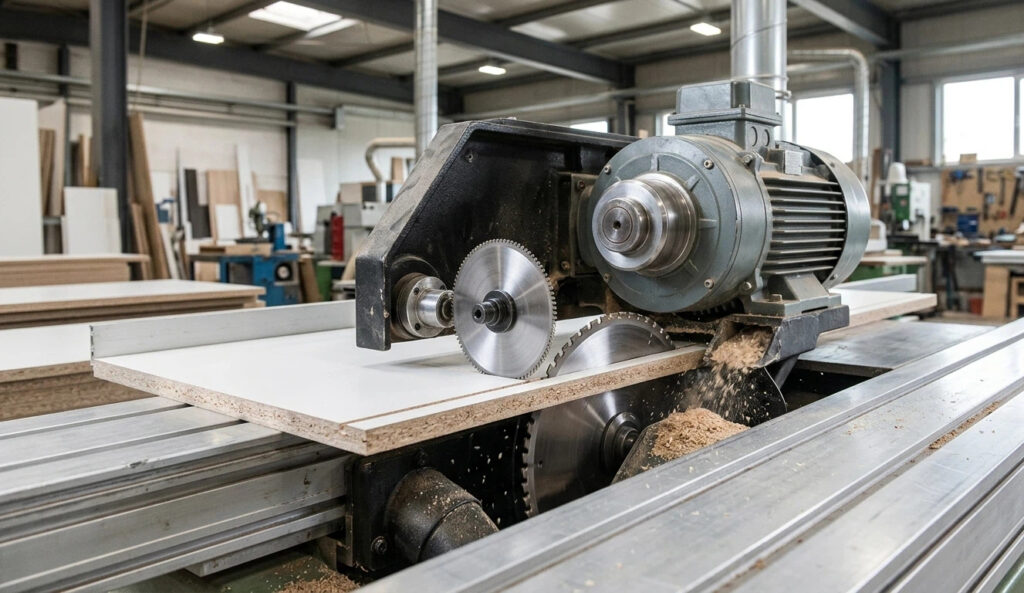
The H45 system represents a leap forward in industrial cutting. Unlike standard table saws, the H45 configuration utilizes two independent blades rotating in opposite directions. The smaller scoring blade leads the way, rotating at a higher RPM to create a shallow groove on the underside of the panel.
This specific scoring blade function ensures that the primary blade, which follows behind, encounters a pre-cut path. Because the fibers or laminate layers are already severed on the bottom face, the upward force of the main blade does not cause the surface to splinter. This synergy is the primary driver behind chip-free cutting in high-output environments.
Power and Stability: The 5.5kW Main Motor
Consistency is the enemy of waste. A machine that vibrates or loses RPM under load will inevitably produce jagged edges. To maintain peak panel processing efficiency, the H45 system is typically equipped with a 5.5kW (7.5HP) main motor.
This motor isn’t just about raw power; it is about thermal stability. During an 8-hour shift in a busy factory, motors generate significant heat. A low-quality motor will experience “thermal drift,” where the spindle expands slightly or the RPM fluctuates, leading to micro-vibrations. The 5.5kW industrial-grade motors used in a high-end MDF cutting machine are designed to maintain a constant torque even when cutting thick stacks or high-density materials, ensuring the blade stays true to its path.
Optimizing for MDF and Melamine Panels
When cutting melamine without chipping, the alignment between the scoring blade and the main blade must be within a tolerance of less than 0.05mm. Any deviation will result in a “step” on the edge, which interferes with the edge-banding process.
For those wondering how to reduce material waste in furniture factory settings, the answer lies in material-specific adjustments. MDF is highly abrasive due to the glues used in its composition. High panel processing efficiency requires using chrome-coated or diamond-tipped (PCD) blades that can withstand the heat generated by the 5.5kW motor without dulling prematurely.
Comparison: Single Saw vs. Dual-Saw H45 System
| Performance Metric | Standard Single Blade Saw | H45 Dual-Saw System |
| Edge Quality | Frequent chipping on bottom face | Chip-free cutting on both sides |
| Material Waste | 5% – 12% due to rework | Under 1% with correct alignment |
| Motor Power | 2.2kW – 3.0kW | 5.5kW High-torque motor |
| Secondary Processing | Requires sanding/trimming | Edge-band ready directly from saw |
| Tool Longevity | Faster dulling due to vibration | Higher stability leads to longer life |
Reducing Waste through Technical Precision
If you are analyzing how to reduce material waste in furniture factory workflows, start with the subgrade and the sliding table. A heavy-duty MDF cutting machine must have a multi-chamber extrusion sliding table. This prevents the “twisting” of the panel during the feed, which is a hidden cause of edge defects.
Furthermore, increasing your panel processing efficiency involves managing the feed speed. While the 5.5kW motor allows for faster throughput, pushing the panel too quickly can overwhelm the scoring blade function, leading to shallow scores that don’t fully clear the exit path for the main blade.
Industrial Standards and Heat Management
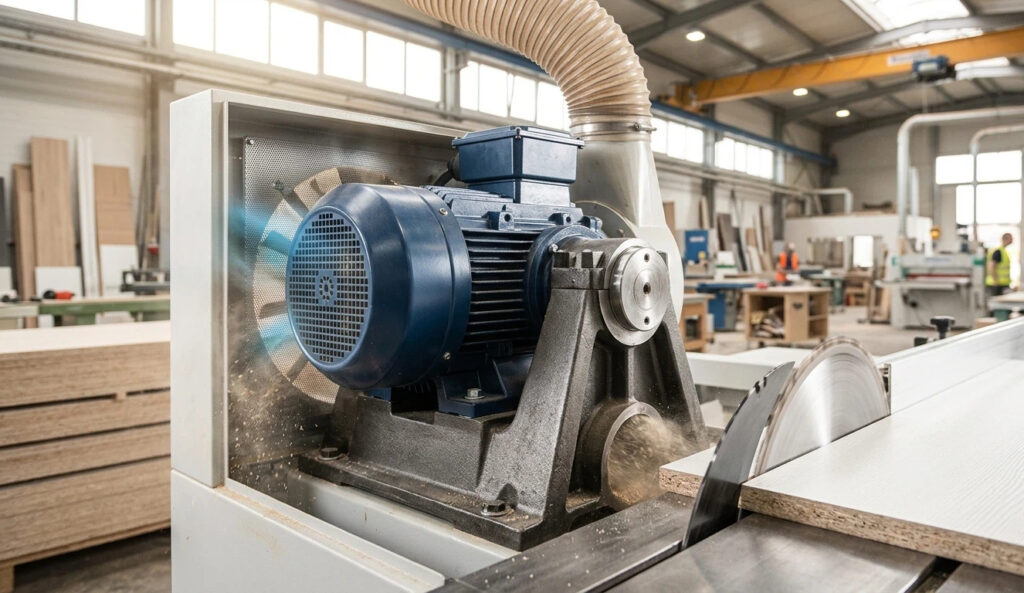
According to technical benchmarks provided by the Woodworking Machinery Industry Association (WMIA), the thermal stability of a spindle is the single most important factor in long-term accuracy. In a high-load MDF cutting machine, the cooling fins and airflow around the main motor must be kept clear of dust.
Failure to manage heat leads to bearing wear, which introduces “run-out.” Once run-out exceeds a few microns, your panel processing efficiency drops because every cut requires manual inspection and correction. High-end systems utilize reinforced cast-iron trunnions to absorb these vibrations and act as a heat sink for the motor.
Conclusion
Maximizing your panel processing efficiency requires a holistic approach: combining the raw power of a 5.5kW thermally stable motor with the finesse of a dual-blade H45 system. When these elements work in harmony, chip-free cutting becomes the standard, not the exception.
Ultimately, understanding how to reduce material waste in furniture factory environments comes down to one thing: precision at the point of impact. With the right dual-saw setup, you can turn every sheet into a perfect component, ready for the next stage of assembly without hesitation.
FAQ
Why is my scoring blade still leaving a mark after adjustment?
This is usually due to a width mismatch. The scoring blade must be slightly wider (approx. 0.1mm) than the main blade to ensure the main blade teeth never touch the edges of the finished surface. This is essential for cutting melamine without chipping.
Can I use the H45 system for solid wood?
Yes, but the scoring blade function is typically retracted for solid wood. The 5.5kW motor provides excellent torque for ripping hardwoods, but the dual-saw setup is specifically optimized for man-made panels.
How does dust collection affect panel processing efficiency?
Poor dust extraction causes debris to build up under the panel, tilting it slightly. This “ghost tilt” ruins the squareness of the cut and increases waste. Always ensure the overhead guard and lower ports are clear.
Is a 5.5kW motor overkill for thin MDF?
Not at all. A larger motor operates at a lower percentage of its maximum capacity, which reduces heat and extends the life of the machine, maintaining higher panel processing efficiency over many years.