
Industry News
Maximizing Furniture Production: How a CNC Disc Cutting Machine Defines Your Factory’s ROI
In the competitive landscape of panel furniture manufacturing, the transition from manual sawing to automated CNC nesting has become a necessity. Achieving high output while maintaining micron-level precision requires more than just a standard saw; it demands a sophisticated Disc Cutting Machine that integrates seamlessly into a modern workflow. Whether you are producing custom cabinets or large-scale office furniture, selecting the right machine configuration is the foundation of your factory’s ROI.
Table of Contents
The Evolution of CNC Technology in Panel Processing
Modern workshops are moving away from single-function tools toward multi-axis nesting centers. A high-performance Disc Cutting Machine today serves as the heart of the production line, handling everything from complex shape routing to vertical drilling and precision grooving. This evolution is driven by the need for “Nesting” technology, which maximizes material utilization and minimizes waste through intelligent software algorithms.
Comparing High-Efficiency Configurations: A16, Linear, and Four-Process
Choosing between different Tool Changer (ATC) systems is often the most critical decision for a buyer. Each configuration of a Disc Cutting Machine offers distinct advantages depending on your specific production volume and complexity.
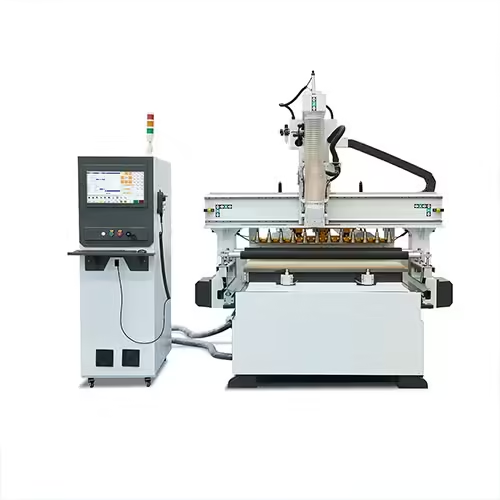
1.The A16 Circular ATC: Speed and Complexity
The A16 model features a 12-to-16-slot circular tool magazine mounted directly on the gantry. This setup is the gold standard for a high-end Disc Cutting Machine.
- The Advantage: By reducing the distance the spindle travels to swap tools, the “chip-to-chip” time is minimized. This is ideal for intricate furniture designs that require frequent bit changes for engraving, routing, and sizing.
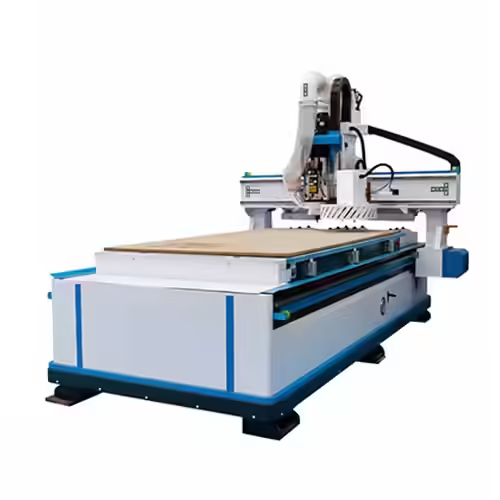
2.Straight-Line (Linear) ATC: Stability and Value
For shops that require high reliability with a lower initial investment, the linear tool changer is a proven solution. In this Disc Cutting Machine setup, tools are arranged in a fixed row at the end of the vacuum table.
- The Advantage: With fewer moving parts in the tool magazine itself, maintenance is simplified. It provides a stable, high-speed solution for factories focused on consistent, high-volume panel sizing.
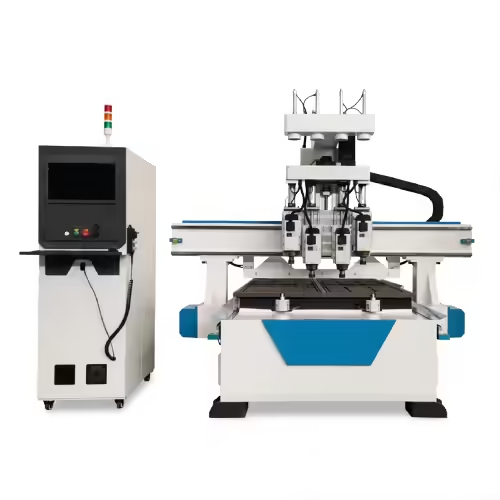
The Four-Process System: Multi-Spindle Integration
The four-process configuration takes a different approach by using four independent spindles. Rather than changing a single bit, this Disc Cutting Machine switches between pre-loaded spindles for different tasks.
- The Advantage: It eliminates the tool-change wait time entirely for tasks requiring four or fewer tools (such as common drilling, grooving, and cutting cycles), making it incredibly efficient for standardized cabinet production.
Engineering Excellence: What Drives Machine Precision?
Beyond the tool changer, the structural integrity of the Disc Cutting Machine determines its lifespan and the quality of the finished edge.
- Heavy-Duty Bed Structure: A high-quality machine must feature a heat-treated, welded steel frame to prevent deformation over years of high-speed operation.
- High-Speed Spindle Performance: The spindle is the “engine” of the Disc Cutting Machine. Using premium air-cooled or water-cooled spindles ensures consistent torque even when cutting dense MDF or thick plywood.
- Precision Driving Systems: Implementing Leadshine or Delta servo motors allows for rapid acceleration and a repetition positioning accuracy of $\pm 0.02\text{mm}$, which is essential for any professional-grade Disc Cutting Machine.
Maximizing ROI through Software and Maintenance
Even the most advanced hardware requires the right digital input. Integrating your Disc Cutting Machine with industry-standard nesting software like Alphacam or Cabinet Vision allows for automatic label printing and optimized cutting patterns. This synergy reduces manual labor and ensures that every square inch of the wood panel is utilized.
Furthermore, long-term profitability depends on consistent upkeep. A well-maintained Disc Cutting Machine should have its vacuum adsorption table cleared of debris daily and its auto-lubrication system checked weekly. These small steps prevent the accumulation of fine wood dust in the lead screws and rails, preserving the machine’s high-speed travel capabilities.
Conclusion
Selecting a Disc Cutting Machine is an investment in your company’s future scalability. For high-frequency, complex custom work, the A16 Circular ATC remains the top choice. For those prioritizing multi-tasking without tool change delays, the four-process model offers unmatched speed.
Ultimately, the best Disc Cutting Machine is the one that aligns with your specific material types, production volume, and desired level of automation. By focusing on spindle rigidity, servo precision, and software compatibility, you can ensure a production line that is both efficient and future-proof.
FAQ
Why does the A16 system offer higher efficiency?
The A16 Disc Cutting Machine features a circular tool magazine mounted directly on the gantry, which minimizes the tool-change travel path for maximum speed.
Is the Four-Process model suitable for my factory?
If your production mainly consists of standard sizing and drilling, this Disc Cutting Machine is the “efficiency king” as it eliminates tool-change wait times entirely.
How can I minimize cutting deviations?
Choosing a Disc Cutting Machine with a high-rigidity spindle and utilizing licensed nesting software will ensure consistent accuracy and a superior surface finish.