
Industry News
How to Choose the Right DIY Woodworking Tools
Table of Contents
Woodworking is an exciting and rewarding craft that allows you to create beautiful and functional pieces, but the success of your projects depends on choosing the right DIY woodworking tools. From power saws to hand tools, using the correct tools for each task can make all the difference. In this guide, we’ll explore how to choose the best tools for DIY woodworking projects and provide essential tips on selecting the right tools for your specific needs.
Why Tool Selection is Crucial for DIY Woodworking

The selection of DIY woodworking tools plays a significant role in the quality and precision of your work. Using the wrong tools for a task can lead to poor cuts, damaged wood, and inefficient work processes. For example, a circular saw may not be ideal for precision cutting, and using an incorrect saw blade could result in splintering or uneven edges. Moreover, using dull or worn-out tools can make your work slower and harder.
On the other hand, the best tools for DIY woodworking projects ensure that you achieve clean, accurate cuts, and enhance both the speed and efficiency of your work. For any woodworking project, whether simple or complex, selecting the right tool is essential to achieve professional-level results.
How to Choose the Best DIY Woodworking Tools for Specific Tasks
1.Table Saws: Ideal for Precision Cutting
A table saw is often referred to as the workhorse of woodworking. It’s perfect for making straight cuts in long pieces of wood, especially when you need precise, repeatable cuts. Table saws are ideal for large DIY woodworking projects like building furniture or cabinets.
When selecting a table saw, consider the motor power, cutting capacity, and the accuracy of the fence system. A high-quality fence will help ensure your cuts remain accurate, and adjustable features allow for different cutting depths and angles.
- Tip: A table saw with an adjustable blade height and a reliable fence system can drastically improve your cutting accuracy.
2.Circular Saws: A Must-Have for Rough Cuts
Circular saws are an essential part of DIY woodworking tools because they offer versatility and portability. Ideal for rough cuts, a circular saw helps you quickly break down large pieces of wood into manageable sizes. They are perfect for rough-cutting large boards before making finer adjustments with other tools.
- Tip: Choose a circular saw with adjustable depth settings and a fine-tooth blade for cleaner cuts on wood without splintering.
3.Jigsaws: Versatile for Curves and Intricate Cuts
If you need to make curved cuts or intricate shapes in wood, a jigsaw is one of the best tools for the job. It’s also useful for cutting out holes in wood or making bevel cuts in smaller projects. A jigsaw is perfect for DIY projects that involve more creative designs, like cutting out shapes for decorative pieces or detailed furniture work.
- Tip: Look for a jigsaw with adjustable speeds and orbital settings for more control over your cutting process.
4.Miter Saws: Precision for Angled Cuts
A miter saw is indispensable for making precise crosscuts and angled cuts, such as 45-degree cuts for picture frames or trim work. If your project involves building frames or working with molding, a miter saw is an excellent tool to ensure that all your pieces fit together perfectly.
Tip: Choose a compound miter saw if your projects require both bevel and miter cuts, offering you more flexibility for different angles.
5.Hand Saws: Precision in Small Projects
While power tools are essential for larger tasks, hand saws are still indispensable for smaller, more detailed projects. Whether you’re cutting small trim or making precise cuts in tight spaces, hand saws offer the control needed to make clean, accurate cuts.
- Tip: A crosscut saw is ideal for cutting across the grain, while a rip saw is better for cuts along the grain.
6.Power Drills: Essential for Drilling and Fastening
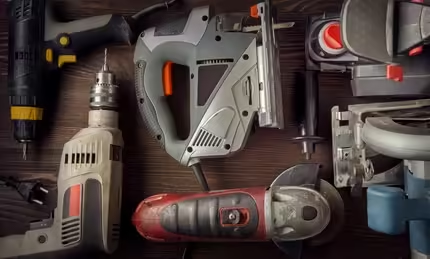
A power drill is one of the most versatile DIY woodworking tools that can handle drilling holes and driving screws with ease. Whether you’re installing hardware, creating pilot holes for screws, or drilling through wood, a power drill is indispensable.
- Tip: A cordless power drill with a variety of drill bit attachments and adjustable speeds can handle a range of tasks from drilling small holes to driving screws into tougher materials.
Tips for Beginners in Choosing DIY Woodworking Tools
As a beginner, it’s important to start with the essentials. You don’t need to buy every tool right away—begin with versatile DIY woodworking tools that can help you complete a variety of tasks.
1.Start with Basic Hand Tools
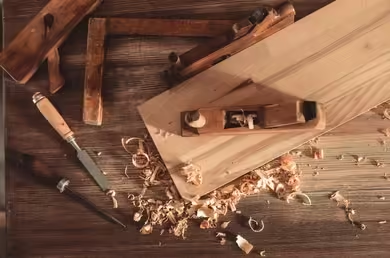
Before investing in high-end power tools, start with some basic hand tools. A good set of hand saws, hammers, clamps, tape measures, and a square can help you get started on small projects and build your woodworking skills.
2.Opt for Multi-Function Tools
For beginners, it’s often more cost-effective to buy multi-function tools. A drill/driver combo can serve as both a drill and a screwdriver, allowing you to perform a variety of tasks without purchasing multiple tools. Additionally, tools like a combination square or adjustable clamps can help you handle several different woodworking jobs with ease.
3.Gradually Add Power Tools
As your skills improve, gradually add more advanced tools such as a table saw or miter saw for precision cutting, or a jigsaw for creative designs. With each project, assess the tools you need, and make informed decisions based on your growing expertise.
4.Choose Tools Based on Your Projects
The tools you need depend heavily on the type of DIY woodworking projects you plan to tackle. For projects like cabinetry and large furniture building, a table saw and miter saw will be essential. If you’re focused on smaller projects, a power drill and hand saws may be all you need.
Conclusion: Invest in the Right Tools for Successful DIY Woodworking
Choosing the right DIY woodworking tools is critical to achieving success in woodworking. Whether you’re a beginner or an experienced woodworker, understanding which tools are necessary for each project will help you work more efficiently and produce high-quality results. Start with the essentials, invest in the best tools for your projects, and gradually expand your collection as you gain experience.
With the right DIY woodworking tools, your projects will turn out with professional-level precision and quality, and you’ll be able to tackle increasingly complex tasks with confidence.