
Uncategorized
Troubleshooting Disc Cutting Machine Errors: A Technical Guide to Calibration and Surface Quality
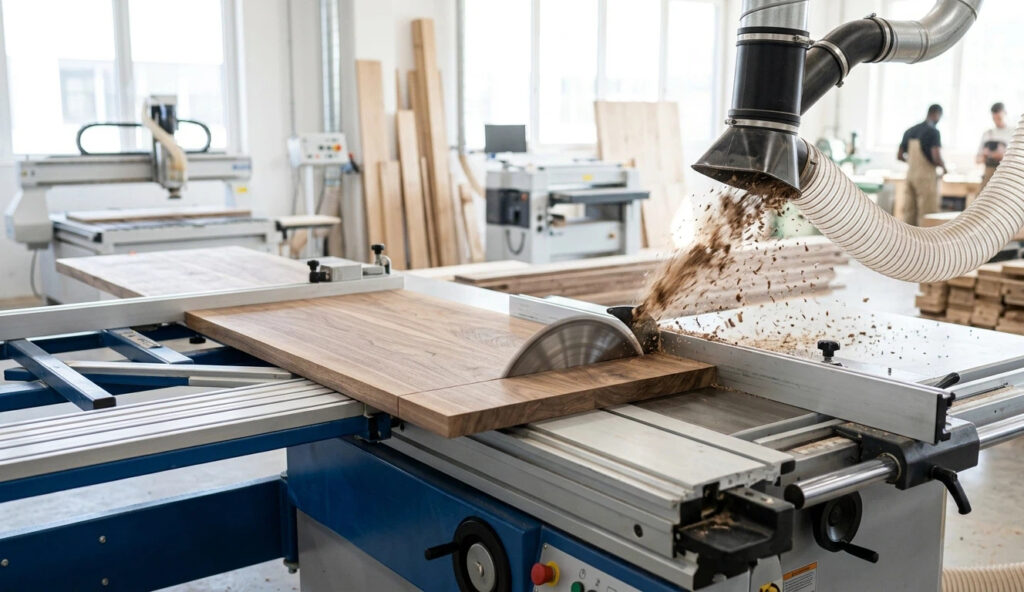
In the industrial woodworking sector, the quality of a finished board is dictated by the accuracy of the primary cut. Whether processing solid hardwood, MDF, or laminated particle boards, Disc Cutting Machine Errors can lead to costly material rejection and assembly issues in downstream furniture production. Achieving a “glue-line” quality cut requires more than just a sharp blade; it demands an understanding of mechanical harmonics and alignment. This guide explores troubleshooting disc cutting surface defects and provides actionable steps for professional machine calibration.
Table of Contents
Diagnosing Common Woodworking Disc Cutting Machine Errors
Wood is an anisotropic material, meaning its properties change with grain direction. Consequently, Disc Cutting Machine Errors often manifest differently depending on whether you are ripping or cross-cutting. The most frequent errors include blade lead (drifting), motor straining, and inconsistent cutting depths.
Systematic sawing machine maintenance is the only defense against these issues. Over time, resin buildup and fine sawdust can infiltrate the spindle housing, leading to micro-vibrations. These vibrations are the root cause of many Disc Cutting Machine Errors, resulting in a “wavy” cut that is unacceptable for high-end cabinetry.
Troubleshooting Woodworking Disc Cutting Surface Defects
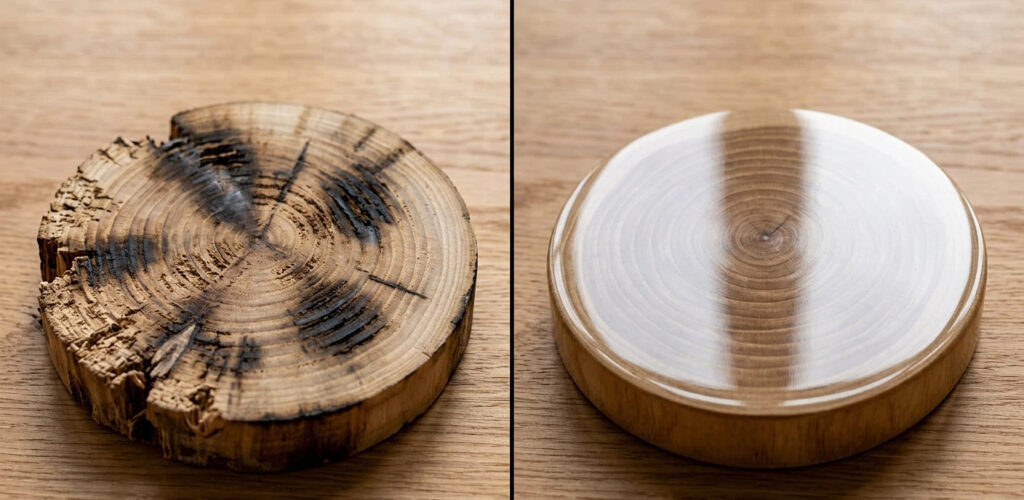
Surface quality in woodworking is measured by the absence of tear-out and thermal degradation. When troubleshooting disc cutting surface defects, operators must distinguish between metallurgical failure of the blade and mechanical failure of the machine.
- Splintering and Tear-out: Common in laminated boards. These Disc Cutting Machine Errors usually occur when the exit angle of the saw tooth is incorrect or the scoring blade is misaligned.
- Burn Marks on Edges: Indicates that the blade is rubbing against the wood rather than cutting it. This is a classic sign that you need to investigate how to calibrate circular saw alignment.
- Wash-boarding (Ripples): Caused by lateral blade movement. This type of troubleshooting disc cutting surface defects typically points to a worn arbor or a bent saw blade.
Addressing these Disc Cutting Machine Errors promptly ensures that your edge-banding process remains efficient and seamless.
How to Calibrate Circular Saw Alignment for Timber
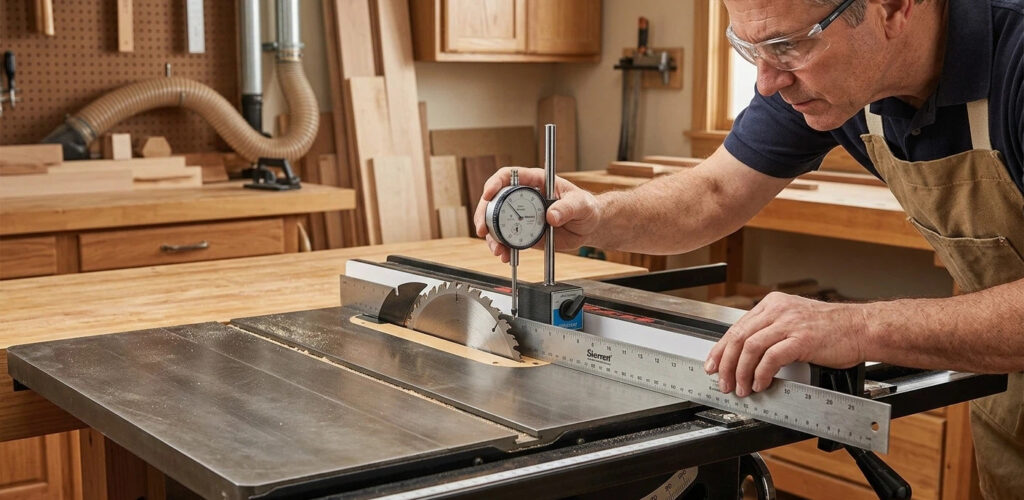
Alignment is the soul of woodworking precision. Knowing how to calibrate circular saw alignment is what separates a professional workshop from a DIY setup. The goal is to ensure the blade, the rip fence, and the sliding table are all perfectly parallel.
The Woodworking Calibration Protocol:
1.Blade-to-Fence Parallelism: Use a high-precision dial indicator to ensure the distance between the blade and the fence is consistent from front to back. Even a $0.1mm$ deviation can cause Disc Cutting Machine Errors like kickback.
2.Arbor Runout Testing: This is a vital part of machine calibration. If the arbor (the shaft holding the blade) has even a slight wobble, it will amplify at the teeth, causing wide kerfs and vibration-induced Disc Cutting Machine Errors.
3.90-Degree Stop Verification: Regularly check that your blade tilt scale is accurate using a digital protractor.
Mastering how to calibrate circular saw alignment drastically reduces the need for sanding and planing after the initial cut.
Specialized Sawing Machine Maintenance for Dust Control
Unlike metalworking, the primary enemy in woodworking is sawdust. High-performance sawing machine maintenance must focus on the extraction system and resin removal. Resin (pitch) from softwoods acts as an adhesive for dust, creating a “crust” on the blade and guide rails.
This crust increases friction, leading to heat-induced Disc Cutting Machine Errors.
- Daily Action: Blow out the motor housing and trunnion assembly with compressed air.
- Weekly Action: Use a specialized pitch-remover to clean the saw blade teeth. This simple step in sawing machine maintenance can prevent the thermal expansion that leads to Disc Cutting Machine Errors.
- Monthly Action: Check the drive belts for tension and cracks. A slipping belt can cause erratic blade speeds, leading to further troubleshooting disc cutting surface defects.
| Component | Wood-Specific Inspection | Action if Error Detected |
| Saw Blade Teeth | Inspect for resin/pitch buildup. | Clean with solvent to prevent friction. |
| Rip Fence | Check for parallelism to the blade. | Perform machine calibration via adjustment bolts. |
| Dust Extraction | Check for blockages in the throat plate. | Clear immediately to prevent heat buildup. |
| Miter Gauge | Verify angle accuracy for cross-cuts. | Follow how to calibrate circular saw alignment steps. |
Material Density and Machine Calibration
The density of the board—whether it is lightweight pine or dense tropical hardwood—dictates the stress on the system. Disc Cutting Machine Errors often occur when operators fail to adjust the feed rate to the material’s specific gravity. According to the Wood Component Manufacturers Association (WCMA) standards, high-density materials require slower feed rates and more frequent machine calibration to maintain tolerances.
Ensuring your machine settings are tuned to the specific board type is the final step in eliminating Disc Cutting Machine Errors.
Conclusion: Optimizing Your Woodworking Output
Reducing Disc Cutting Machine Errors is about consistency. By combining proactive sawing machine maintenance with a deep understanding of how to calibrate circular saw alignment, you can achieve industrial-grade results every time. Remember, troubleshooting disc cutting surface defects is not just about fixing a problem—it’s about understanding the science of the cut to prevent future downtime.
FAQ
Why is my saw blade burning the wood?
This is one of the most common Disc Cutting Machine Errors. It usually means your blade is dull or the rip fence is not parallel to the blade. Check your machine calibration.
What causes wood to splinter at the end of a cut?
Focus on troubleshooting disc cutting surface defects by checking your “zero-clearance” throat plate or the alignment of your scoring blade.
How often should I clean my woodworking saw blade?
In a high-volume shop, daily cleaning is recommended as part of your sawing machine maintenance to prevent pitch buildup.
Is it normal for a circular saw to vibrate?
No. Vibration often leads to Disc Cutting Machine Errors. It usually indicates a bent blade or an arbor runout issue that requires immediate machine calibration.